
The Wizard Liz · · 9 min read
The Wizard Liz on Surviving Abuse, Rebuilding Self-Worth, and Becoming a Mother
Read how Healing after abuse shapes money, motherhood, and self-worth in Wizard Liz’s story. Learn what changed and take the lesson with you.
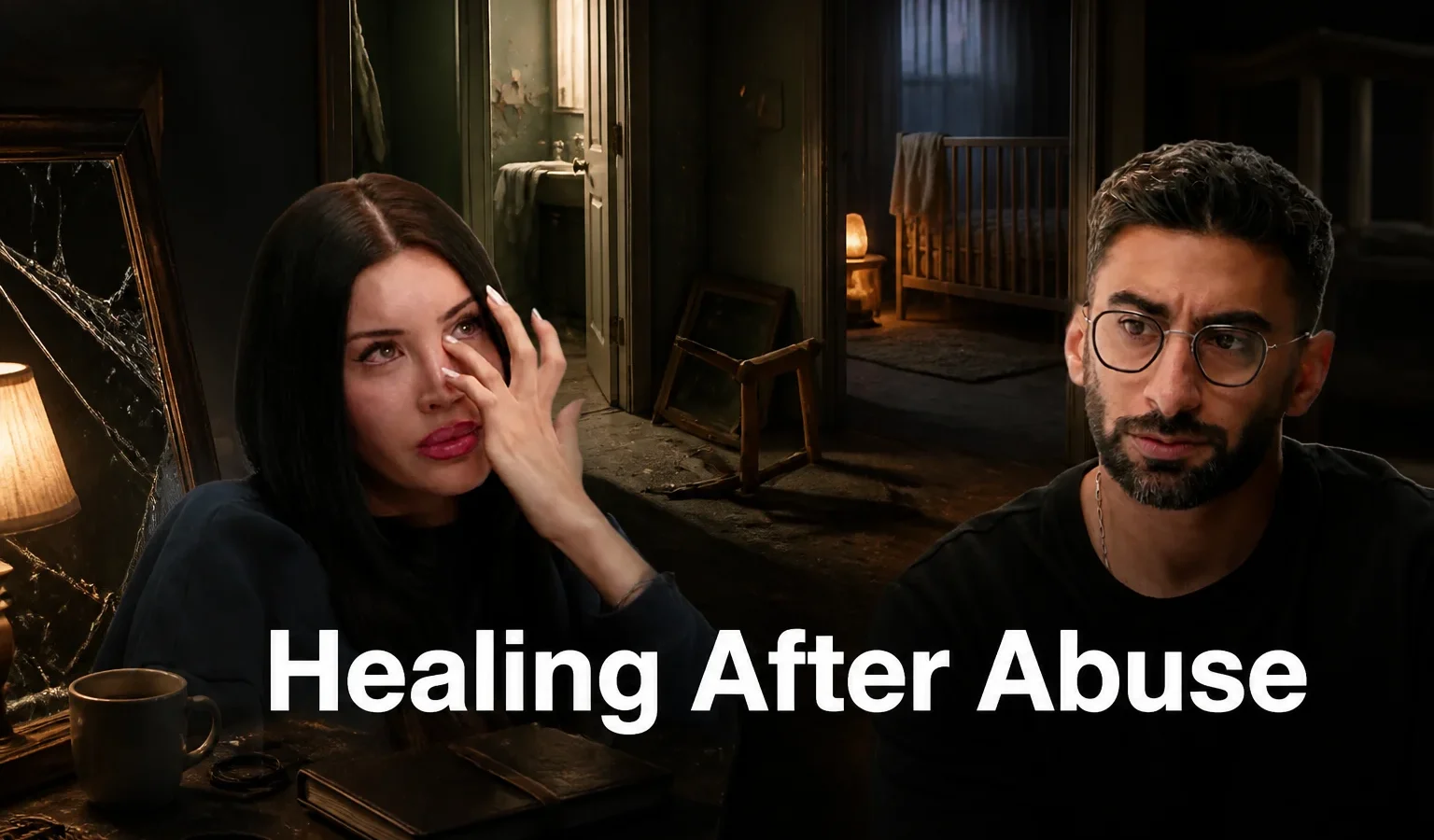
This article draws on our conversation with Liza Jubrailova.
Healing after abuse, in Liza Jubrailova’s account, is not a soft journey of positive affirmations. It is survival turning into self-respect, money turning into safety, and motherhood turning into a line she refuses to let violence cross.
She describes her life as a 27-year survival story, saying she feels numb because so much has happened that she had to survive rather than live (4:07). That frame runs through everything here: childhood control, refugee hardship, online work, betrayal during pregnancy, and the way becoming a mother changed what strength now means to her.
How did abuse shape Liza Jubrailova’s trust and sense of self?
Liza Jubrailova says abuse trained her to live guarded, lonely, and suspicious of people long before fame or relationships entered the picture. She ties that directly to growing up under a controlling father who did not allow friends, did not allow a normal social life, and limited her movements to school or work.
She says she still keeps in touch with one school friend, Nasira, which tells you how narrow that world was. Childhood did not teach ease or openness; it taught monitoring, fear, and isolation. A recovered memory from when she was around 8 sits inside that story, as do later attempts to earn money by selling decorated waffles at 12 and waiting until she was 15 turning 16 before it became legal for her to work (20:14).
“I genuinely hate this person.”
— Liza Jubrailova (23:08)
She says that about her father while also connecting his control to the adult habits people often misread as coldness. Trust, in her version of healing, does not break once in one bad romance. It gets built wrong from the start when a child learns that home is where power humiliates you.
She also recounts physical abuse in blunt, ordinary moments that expose how small the triggers could be: being beaten over $5, spit on for spending $2.00 extra, dragged by the hair, and stamped in the face. Those details explain why she talks less about becoming softer and more about becoming safer.
What happened to her family after they became refugees?
Her family’s refugee years were marked by dependence, fear, and money that never reached the people who needed it most. She says her mother was forced to marry her father, tried to escape on her wedding night, and then lived through 25 years of hell after that marriage began (16:25).
After war and immigration, the family received around 10,000 to $15,000 in refugee support for her disabled older brother. She says her father took that one-time payment and sent it back home, while her mother had to beg for $5 to buy bread (24:35). Another memory is even tighter and sadder: if her mother is 5 minutes late from work, the family panics because they do not know what has happened to her (41:31).
Her mother’s work history carries the whole section on its back. She cleaned toilets for $10 a week, packed boxes in a factory, and sold gold jewelry so the children could have school carnival costumes and later celebrate at McDonald’s. There is no abstract lesson in that. The point is the sequence of jobs, the tiny amounts, and what was sold so the children could feel normal for a day.
One of the most painful details comes from inside the house itself: her mother once asked her to take $5 from his wallet to buy bread, and she says she was then beaten over it (44:28). In Jubrailova’s telling, refugee struggle was not only about starting over in a new country. It was also about private terror continuing inside the home.
Why did money become central to her healing after abuse?
Money became central to her healing after abuse because she saw early that a woman without her own income can be trapped in somebody else’s violence. She does not talk about wealth as status. She talks about money as exit, food, housing, and the right to make a decision without asking permission.
Her first YouTube paycheck went to her mother. After that, she says she began giving her a monthly allowance, and later paid off her house so her mother would not have to work another 15 years to clear it (46:54). That detail matters because it turns success into a practical act: fewer shifts, fewer humiliations, fewer ways to be cornered by dependence.
She also says social media started from that same motive. She did not begin online to become a relationship coach telling women to date rich men. She began because she wanted to help her mother and women like her, and she says she has now been on social media for seven years (1:40:23).
That is where her argument about financial independence sits. Provision, in her view, is not flashy wealth. A man does not prove love by showing luxury if loyalty and respect are missing, and a woman does not protect herself by waiting to be saved. Healing after abuse, as she describes it, includes building enough stability that you are not forced to stay where you are being diminished.
What did being cheated on while pregnant change for her?
Being cheated on while pregnant changed her standard for love by stripping romance away from loyalty, respect, and truth. She says her ex mirrored her, and that the bond felt convincing enough that she built a future around it, only to find out at four months pregnant that he had cheated (29:34).
“I honestly wish it was a lie.”
— Liza Jubrailova (45:40)
She treats that moment as more than heartbreak. It becomes proof that love on its own is a weak measurement if it does not come with behavior you can rely on. In her account, provision is not about dating rich men or chasing status. Provision means practical care, emotional safety, and not putting a pregnant partner into crisis.
She also rejects the idea that another woman’s value explains a betrayal.
“No, a cheater will cheat on anyone.”
— Liza Jubrailova (2:36:01)
That line pushes against the habit of turning somebody else’s disloyalty into a woman’s self-assessment. Her argument is plain: if someone cheats, the fact of cheating belongs to the cheater. It does not become evidence that the betrayed woman lacked beauty, worth, or effort.
That matters in the larger story because her version of healing does not ask women to become more pleasing. It asks them to stop measuring themselves by what a dishonest person was willing to do.
Why did co-parenting become a trap instead of a solution?
Co-parenting became a trap, in her account, because moving for the child did not create safety, cooperation, or respect. She says she moved to the United States to try to co-parent, but instead felt cornered by legal battles, distance, and losing ordinary access to her son.
She says she spent $50,000 on lawyers and still went through stretches without contact. The detail she gives for loss is painfully exact: the last time she saw him was the 26th of April. That precision is the opposite of a vague complaint. It is how a parent marks absence when the system around them feels impossible to control.
“You can do anything to me, as you choose to the public.”
— Liza Jubrailova (2:11:58)
Her account of that period links private grief with public exposure. She describes a situation where harm does not stay personal once your life is visible online, and where motherhood does not protect you from being trapped inside someone else’s choices.
What she keeps returning to is the same standard she applies elsewhere: love without respect does not hold. Having a child with someone does not create character in that person. It only reveals whether character was there already.
What does motherhood change in her view of strength?
Motherhood changes her view of strength by making protection more concrete, more physical, and less negotiable. She describes becoming a mother as natural and life-changing at the same time, but the shift she dwells on most is responsibility.
“Your child is not your punching bag.”
— Liza Jubrailova (1:06:15)
She places that line against the cycle she came from. A parent’s pain does not excuse using a child as the nearest target, and having suffered yourself does not turn cruelty into fate. Her goal is to break generational patterns so her son remembers her as a powerful woman and a fighter, not as somebody who passed the wound on.
That also explains why she rejects a victim mindset. She does not deny what happened. She recounts it in ugly detail. What she refuses is building an identity around permanent helplessness. Motherhood, in her account, raises the standard: you do not get to repeat what was done to you and call it damage talking.
She presents love here as action, not sentiment. To protect a child is to change the pattern in the room, even when that demands distance, work, money, and the kind of discipline that nobody applauds in private.
How does she explain building a public voice after surviving all that?
She explains building a public voice as a decision to speak from lived experience without pretending that audiences always reward honesty. The online persona people know did not begin as branding. It began as work, survival, and an attempt to create options that did not exist in her mother’s life.
“People say they want authenticity. They want that, but they don’t.”
— Liza Jubrailova (1:41:28)
Her point is not that honesty is useless. It is that public attention often punishes the very thing it claims to admire. That tension sits underneath her seven years online and helps explain why she sounds both open and guarded at once.
She also frames manifestation in practical rather than mystical terms. She describes it as directing energy, not woo-woo magic, which keeps the idea close to effort and focus instead of fantasy. In that setup, you do not wish your way into a new life. You direct your attention, work, and choices toward a different one.
That matches the rest of what she says about healing after abuse. She does not present recovery as purity, perfect peace, or a tidy ending. She presents it as building enough inner and financial strength to stop handing your future to the people who hurt you.
Listen to the full episode
Listen to the full conversation on Spotify — the episode goes further than any article can, and following the show means you catch the next one.
 Watch this episode on YouTube ·
 Listen on Spotify · Subscribe to #ABtalks
Links from this episode
Mentioned in the episode. Some of these may be affiliate or sponsored links.