
Sir Mo Farah · · 5 min read
How Did Mo Farah Become an Olympic Champion?
See how Olympic distance running shaped Mo Farah’s rise through setbacks, heavy training, and race craft. Read the full story.
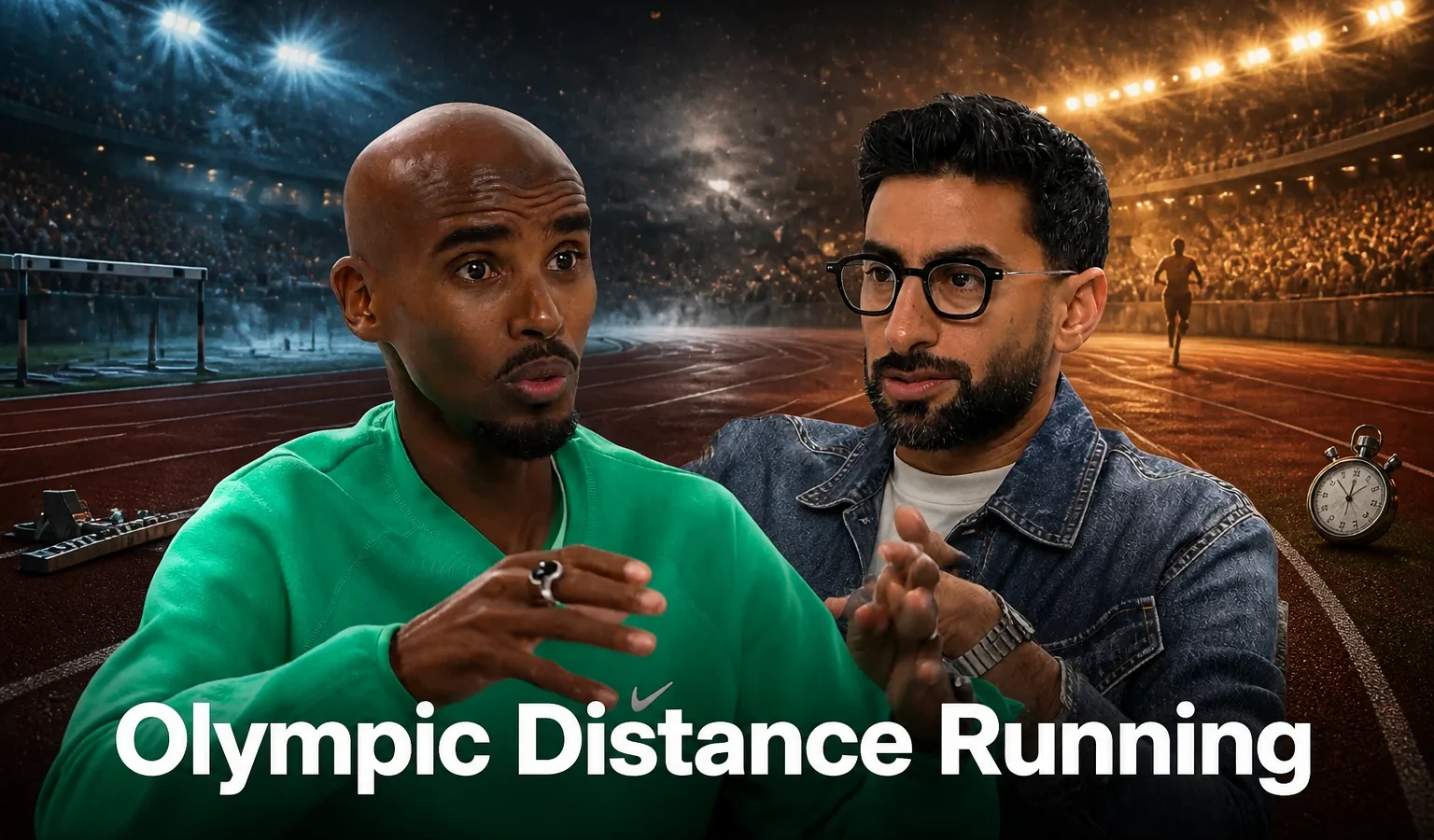
This article draws on our conversation with Sir Mo Farah.
The hard part of an Olympic champion’s story usually isn’t the medal stand. Olympic distance running gets built in quieter places: a local club session, a training camp, a stretch of failure that doesn’t look like progress until years later. That’s how Sir Mo Farah describes his own route, with long phases of work, a missed target in 2008, and then a narrow, relentless focus on getting ready for London.
He puts one marker on that climb very clearly. Sir Mo Farah says he won the Olympics in 2012, and when he looks back on that race year now he still thinks, how did I do it, because during it there was no room for reflection, only the race in front of him (39:23).
He built his Olympic distance running step by step, not in one leap
Farah says his progress came in stages that were easy to name and hard to rush: running club, then Middlesex, then England, then Great Britain. That matters because his version of development was not a sudden discovery of talent. It was selection, exposure, and moving up each level only after he had earned the next one.
One early moment stayed with him. He says a breakthrough came when he represented Great Britain at the European under 16 in Poland, which gave him a first real look at what higher-level competition demanded. Later, he attended a two-week Florida training camp with about 50 athletes, and that kind of environment widened the frame again. You can hear the pattern in the way he tells it: each step gave him a stronger field, a bigger standard, and a better sense of where he stood.
That also explains why his training story can’t be separated from placement and opportunity. A club gave him the base. Middlesex gave him a stronger pathway. England and then Great Britain changed the level of expectation. By the time he was racing internationally, he was not learning what competition felt like for the first time. He had already been moved through enough stages to understand that the next jump always asks for more than the last one.
What training helped Mo Farah become Olympic champion?
Farah says the work behind his Olympic distance running was brutally heavy, but he also describes a method inside that load. He spent six months of the year up in the mountains, and at certain points he put his body through 120 miles a week for 8 weeks, then rested and went again. That is not a random picture of suffering. It is a cycle: accumulate, recover, repeat.
He also draws a line between training and racing that tells you a lot about how he managed himself. Farah says he enjoyed racing most because he was not going in too fatigued. That sounds simple, but it explains why huge mileage was only one part of the plan. The aim was not to feel wrecked all year. The aim was to arrive at the right races with enough strength left to use what he had built.
The mountains, the blocks of volume, and the rest periods all point to the same idea. He was willing to push his body very hard, but he was not treating exhaustion as a badge of honor. He wanted the training to sharpen the race, not swallow it. In his account, the load was extreme because the target was extreme, yet the structure still mattered: hard periods, a reset, then back to work.
After 2008, he rebuilt his Olympic distance running around confidence and race intelligence
Farah says missing the Olympic final in 2008 did not end the project; it reset it. He describes rebuilding through 2009, 2010 and 2011 toward London, which turns the story away from a single bad championship and toward a longer response. The result people remember is the medals, but the part he stresses is the rebuild.
He separates that rebuild into mental and tactical pieces as much as physical ones. Farah says his edge came from belief, confidence, and race intelligence. He studied rivals’ races, looked at how many races they had done in the year, watched how they were looking, and measured that against his own position in the field. He also understood his finishing kick better than they did, which let him judge when a race was still alive for him and when it was time to strike.
That way of thinking helps explain another line from the conversation. In one question, his medal haul at a single Olympics is framed as two, and Farah’s wider record in the sport is four Olympic medals overall (42:51). The point in his own account is not the total by itself. It is that the results came after he learned how to pair hard training with self-belief and with close reading of the people he had to beat.
Listen to the full episode
Listen to the full conversation on Spotify — the episode goes further than any article can, and following the show means you catch the next one.
 Watch this episode on YouTube ·
 Listen on Spotify · Subscribe to #ABtalks
Links from this episode
Mentioned in the episode. Some of these may be affiliate or sponsored links.