
Yo Yo Honey Singh · · 9 min read
Yo Yo Honey Singh on Bipolar Disorder, Fame, Faith and Starting Over
Read the Honey Singh recovery story through his own words on bipolar disorder, fame, faith, roots, and starting over.
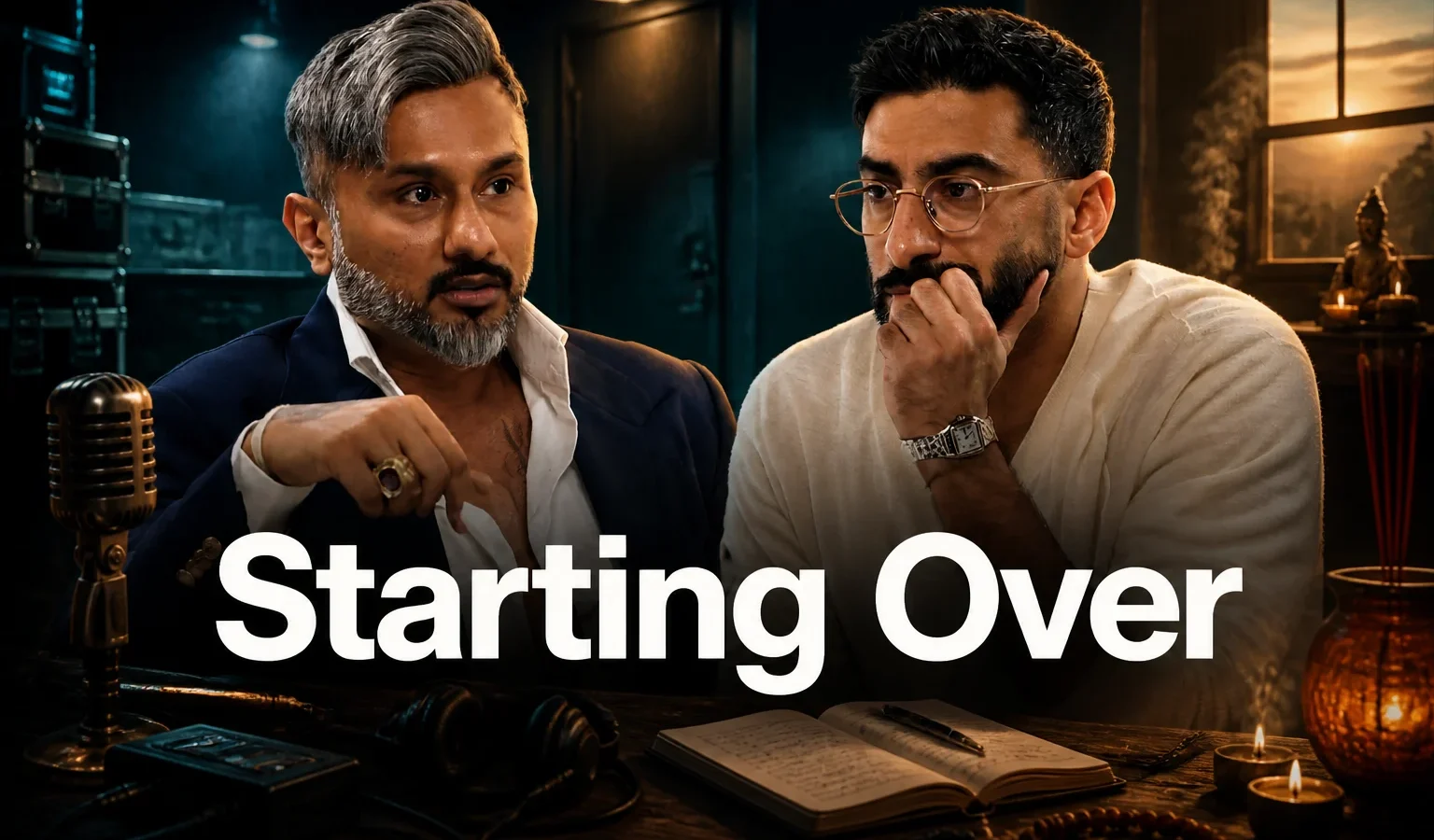
This article draws on our conversation with Yo Yo Honey Singh.
Seven years disappeared behind a locked room, shut curtains, and a mind that turned every sound into a threat. Yo Yo Honey Singh says the collapse people saw from the outside was, for him, a long private fight with bipolar disorder, drugs, fear, faith, and the slow work of getting his life back.
He places the start plainly: he says he was sick for seven years (0:48). He also says that when he looked back at that stretch, he remembered being locked in a room at home 10 years back, eight years back, and seven years back, not talking to anyone, not meeting people, and cutting himself off from the internet, radio, television, media, and what he called running information (1:14).
What did Yo Yo Honey Singh say about bipolar disorder?
Yo Yo Honey Singh says his bipolar disorder began after drugs had already pulled him off balance, and he describes the early signs as suspicion, fear of death, and fear of people. He says he got sick in 2014 after two years of drug addiction from 2012 to 2014, mostly hashish (2:22).
What makes his account specific is how physical and social the illness became. He does not describe a bad phase or a vague breakdown. He describes withdrawal in the most literal sense: staying inside, refusing contact, and avoiding any stream of outside information because even ordinary input became too much to hold.
“I didn’t got the death, I got the purpose to live.”
— Yo Yo Honey Singh (4:43)
He ties the darkest part of that period to a night in 2019 when he says he surrendered to God and asked for death, only to come away with a reason to keep going (4:43). That line matters because he does not present recovery as a clean medical switch. He presents it as survival first, then treatment, then a longer return to ordinary life.
He also separates quitting drugs from getting well. He says stopping in 2014 was only the beginning, and that getting stable still took 7 to 8 years after that (46:23). That gap is a big part of his story. In his version, the substances opened the door, but the illness did not leave just because the drugs did.
Why did recovery take so long?
Recovery took so long, in his account, because getting off drugs did not solve the deeper illness, and the right treatment arrived years later. He says it took 7 years before he found a good doctor and started to turn things around in a lasting way (46:06).
He places that medical turning point in 2021, when a new doctor changed his medication and helped him revisit symptoms and memories so the work was not just about short-term relief, but about fixing things for life. The language he uses is practical. He is not talking about a miracle cure. He is talking about finally getting treatment that matched what he was actually dealing with.
That helps explain why the public timeline can look confusing from the outside. A person can stop drugs and still remain sick. A person can return in fragments and still not feel whole. His version of recovery is slow, uneven, and full of dead time that other people often mistake for absence or failure.
There is also a warning in how he tells it. He does not frame the years after 2014 as a victory lap for quitting. He frames them as proof that damage can outlast the habit that helped trigger it. If you listen to the sequence he gives, the harder truth is that the body stops first and the mind catches up later, if it does at all.
Why was Honey Singh unhappy at his peak?
Honey Singh says fame did not protect him from collapse because the years people call his peak were also the years he was least in control of himself. He points to 2012, eleven and 14 as the period when he was at the top and not in his senses, consumed by anger, ego, drugs, and even calling himself God (30:14).
That is a harder story than the usual rise-and-fall version. The success was real. So was the damage happening inside it. He traces the public high point back to a much earlier spark, saying A. R. Rahman inspired him after he heard him in 1993. He says his first big song arrived in 2005, which makes the later crash feel less like a sudden detour and more like pressure building after a long climb.
The biggest gamble he describes from that climb is the video for Brown Rang. He says he spent about $60,000 from near about $100,000 in savings on the Dubai shoot, and that Brown Rang changed his life. That detail matters because it shows the scale of belief behind the hit. He was not just riding momentum. He was staking almost two-thirds of what he had saved on one move.
The gap between the outside picture and the inside one runs through this part of his story. Massive songs, money, and recognition did not produce peace. In his telling, the peak years carried ego and isolation right alongside success.
How faith changed the Honey Singh recovery story
The Honey Singh recovery story turns on surrender as much as medicine, because he says faith gave him a reason to keep living before treatment fully began to work. He describes 2019 as the night he gave up fighting on his own terms and turned to God.
That is where his account changes tone. Up to that point, the story is fear, suspicion, and being trapped inside his own home and head. After that point, he starts talking about purpose. Not instant happiness. Purpose.
“You may not going to get the second chance.”
— Yo Yo Honey Singh (31:54)
He uses that idea as a warning about wasted time and reckless living (31:54). The sentence sits naturally beside his account of survival: if a person gets another opening after years of illness, drugs, and self-destruction, the response cannot be casual.
“Death is the biggest promise and is the reality.”
— Yo Yo Honey Singh (1:11:45)
He treats mortality as a fact that strips away illusion (1:11:45). In the same stretch of thought, he talks about what matters now with much less swagger than the image that once made him famous. Love matters most in his present value system, and he speaks about wanting children and a more meaningful kind of success, not just another run at the same old peak.
Karampura, childhood shame, and the ambition that followed
Karampura remains central to how he sees himself, because he ties his hunger to growing up there while studying among richer kids elsewhere. He says an inferiority complex formed early when he attended a school in a wealthier area and felt the class difference in real time.
He connects that feeling to one school memory in particular, an incident with the principal when he was 12 or 13 (1:09:11). He uses childhood here not as decoration, but as explanation. The need to prove himself did not begin with charts, money, or celebrity. It began with humiliation, comparison, and the feeling of not belonging in the room.
That background also explains why Karampura is not just a hometown reference for him. It is the place he still uses to measure whether fame changed him too much.
“I never going to forget these streets, no matter how big I go.”
— Yo Yo Honey Singh (24:01)
The line turns roots into a discipline instead of a slogan (24:01). He also speaks with devotion about his parents, and that fits the same pattern. Family, in his account, is not an accessory to success. It is the thing that kept meaning attached to it.
What does he say about love, divorce, and being alone?
He says loneliness is unavoidable in the end, and that belief shapes how he talks about divorce, friendship, and the people around you during success. The romantic version of fame does not survive this part of his account.
“Sometimes there’s no way back.”
— Anas Bukhash (48:11)
The pushback from Anas Bukhash brings out a hard line on broken relationships and choices that cannot always be reversed (48:11). Singh’s own answer to that part of life is severe and stripped down.
“If you came alone, you’ll go alone.”
— Yo Yo Honey Singh (55:15)
He uses that to place limits on what other people can finally do for you (55:15). Even so, he does not end up glorifying isolation. He says love matters most, which makes his position sharper rather than softer: people matter deeply, but no crowd can save you from yourself.
That also feeds into how he talks about friendship. He is less interested in loyalty as a public performance and more interested in who remains real when the noise drops. The same man who once chased the highest version of fame now talks as if the deeper question is who stays human around power, pain, and absence.
Starting over now means family, meaning, and his own label
Starting over, as he describes it now, means building a quieter future with more control over his work and more meaning in his private life. He says his goals today include children, a fuller idea of success, and creating what he calls India’s first artist-made label after deciding a month back to stop working with labels.
That decision fits the rest of the story. The younger version he describes wanted scale, recognition, and impact at any speed. The present version sounds more interested in ownership and intention. Building his own label is not presented as a branding stunt. He frames it as the next structure for a life he had to rebuild from the inside out.
There is a straight line from Karampura to that choice, and from the locked room to that choice too. He talks like someone who no longer wants to hand the shape of his life to fame, addiction, panic, or an industry machine.
The story he leaves behind is not a neat redemption arc. It is a record of relapse, treatment, prayer, ambition, and loss, followed by a different idea of what winning should look like.
Listen to the full episode
Listen to the full conversation on Spotify — the episode goes further than any article can, and following the show means you catch the next one.
 Watch this episode on YouTube ·
 Listen on Spotify · Subscribe to #ABtalks
Links from this episode
Mentioned in the episode. Some of these may be affiliate or sponsored links.