
Yo Yo Honey Singh · · 4 min read
What Did Yo Yo Honey Singh Learn About Friendship and Divorce?
Read Honey Singh divorce lessons on solitude, loyal friends, and love after collapse. See what he says and take the insight with you.
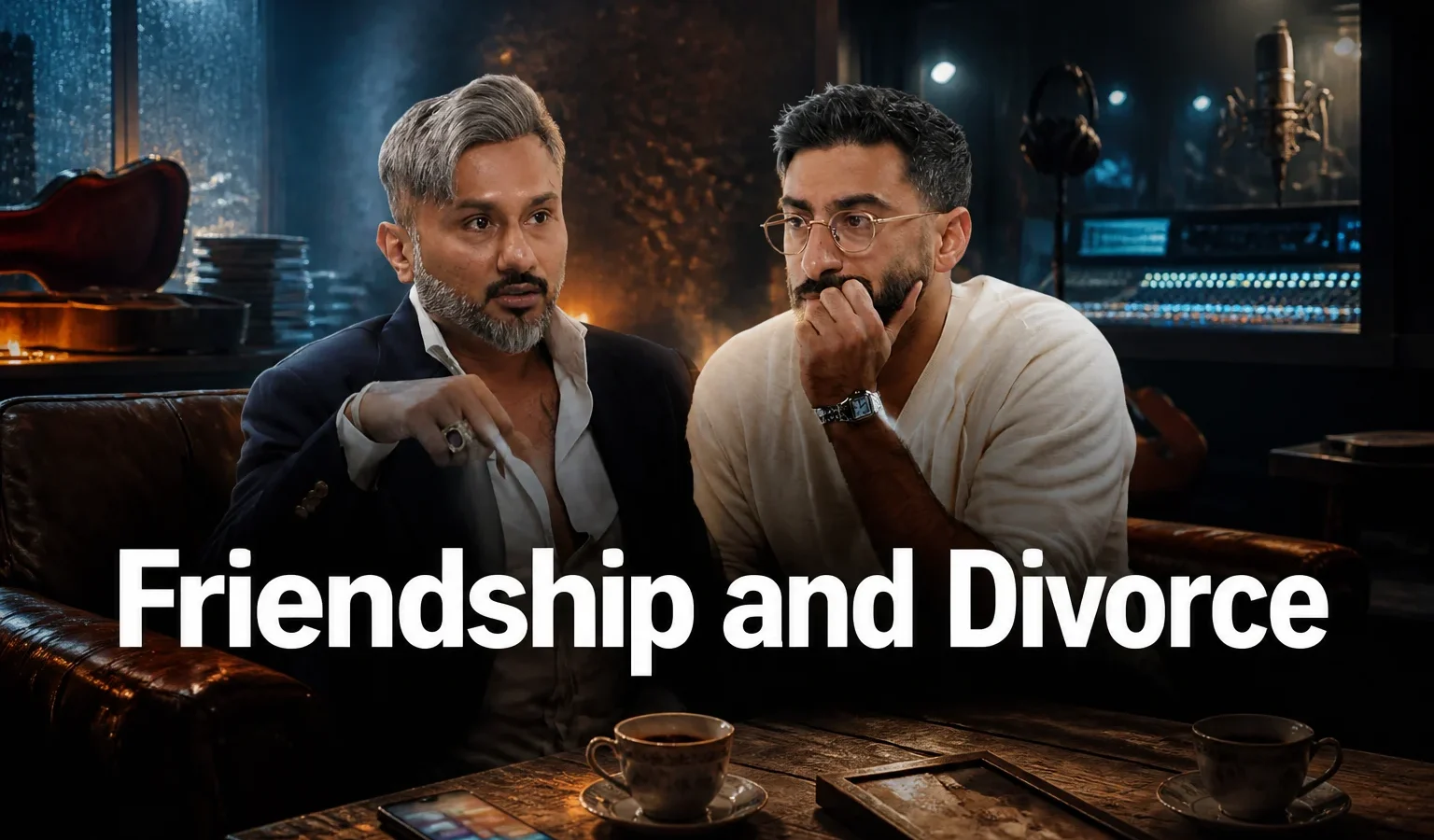
This article draws on our conversation with Yo Yo Honey Singh.
Fame fills the room fast, but divorce and illness stripped the room back down for Yo Yo Honey Singh. His answer to friendship and divorce is that crowds gather around success, pain shows you who stays, and you have to learn how to stand alone without turning cold.
He ties that lesson to two hard experiences at once: the end of a marriage and the period when he got sick. In speaking about both, he does not drift into gossip or blame. He keeps returning to one idea instead: public love is noisy, real loyalty is quiet, and adulthood means preparing yourself for the fact that even the people you love most will not walk every mile with you.
What did divorce teach Yo Yo Honey Singh about being alone?
Divorce taught him that a person has to accept solitude as a fact of life, not as a punishment. He says you come into life alone, you leave alone, and if you fight that truth, every loss will break you twice.
That is where his spiritual framing comes in. He does not present being alone as bitterness, exile, or defeat. He presents it as preparation. If you know from the start that no relationship can remove the basic aloneness of being human, then you stop demanding the impossible from other people.
“If you came alone, you’ll go alone.”
— Yo Yo Honey Singh (55:15)
He extends that thought beyond marriage. Even parents, in his telling, will not stay forever, so emotional maturity means learning how to live with your own company. That is a severe lesson, but he does not use it to dismiss love. He uses it to lower the fantasy that another person can permanently rescue you from yourself.
That matters because his comments on divorce are not really about legal separation or celebrity scandal. They are about what remains after the collapse of an intimate bond. What remains, in his account, is the work of becoming steady enough that loss does not turn into permanent resentment.
What happened to Yo Yo Honey Singh’s friends when he got sick?
When he got sick, the crowd around him disappeared, and he says that exposed the difference between access and friendship. At the time when he was Yo Yo Honey Singh, about 40 boys and friends used to walk with him, but once illness hit, everybody left except his childhood friend Rohit (54:17).
That single detail does most of the work. You do not need a theory of fame to understand it. A man can move with 40 people and still discover, in crisis, that only one friend is actually standing there when the noise stops.
He names Rohit because the point is not abstract loyalty. It is one person from before the success, before the public identity, before the comeback. Singh’s account draws a line between people who were attached to the star and the friend who stayed with the man.
He also says that after his comeback, everybody started coming back. He does not pretend not to notice the pattern. Success rebuilt the crowd just as sickness had emptied it. That is his lesson about friendship after fame: public success creates orbiting people, but suffering reveals the small number, sometimes the single person, who remains when there is nothing to gain.
He does not turn that realization into a rant against people. He treats it more like an awakening. If you expect crowds to behave like family, you will keep getting hurt. If you understand what fame attracts, you can value the rare friend who stays without being shocked by everybody else.
Did those experiences make him give up on love?
No, those experiences did not make him reject love; he still describes love as the most beautiful, amazing, and important thing in life. What changed is the scale of his expectation and the depth of his understanding.
He says Ishq happens once with the Mahboob, and that final love is not necessarily the first. That idea sits neatly beside everything else he says about divorce and friendship. A broken relationship does not prove love was fake. A crowd leaving does not prove attachment is worthless. It proves that not every attachment deserves the same name.
His way of putting it keeps both truths alive. You should not become naïve about people just because you want connection, and you should not become bitter just because pain exposed something hard. Love still matters most. It just cannot be confused with popularity, dependency, or the temporary warmth that surrounds a successful person.
So the lesson he draws is narrow and demanding. Learn to be alone. Recognize the friend who stayed. Keep room in your life for love anyway.
Listen to the full episode
Listen to the full conversation on Spotify — the episode goes further than any article can, and following the show means you catch the next one.
 Watch this episode on YouTube ·
 Listen on Spotify · Subscribe to #ABtalks
Links from this episode
Mentioned in the episode. Some of these may be affiliate or sponsored links.