
Yo Yo Honey Singh · · 4 min read
What Did Yo Yo Honey Singh Say About Living With Bipolar Disorder?
Read what Yo Yo Honey Singh said about living with bipolar disorder, from fear and isolation to treatment and change. Learn the full story.
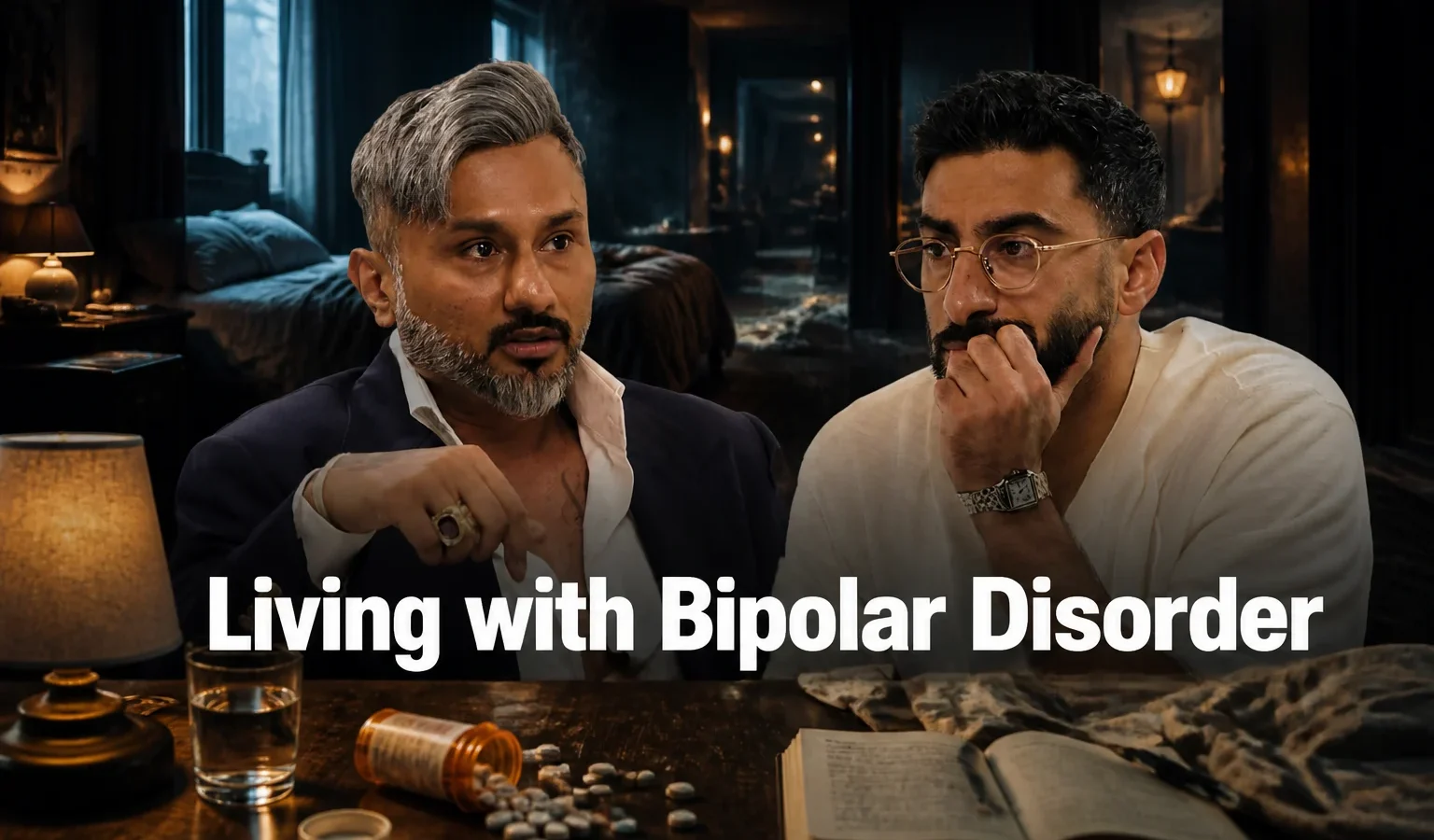
This article draws on our conversation with Yo Yo Honey Singh.
Yo Yo Honey Singh says living with bipolar disorder felt real while it was happening, and that’s the part he keeps returning to. He says the illness did not look like a passing bad phase from the inside; it looked like truth.
He says he got sick in 2014 (2:22), and he also says he is still a patient of bipolar disorder even after returning to shows, travel, and music. The picture he gives is not of a clean before-and-after recovery story. It is a long stretch of illness, treatment, and slow return.
What did Singh say bipolar disorder felt like from the inside?
Singh says bipolar disorder began for him with suspicion, fear of death, and fear of people, and he describes those thoughts as completely convincing in the moment. He does not present the experience as ordinary worry. He says negative thoughts, deaths, and paranormal activities seemed true to him, as if he were wearing VR glasses and seeing a false world as reality.
That comparison matters because he is trying to explain why the illness was so consuming. He says the mind does not announce that it is misleading you. It makes the fear feel factual. In his account, suspicion spread to everything around him, and the result was isolation, silence, and a complete break from normal life rather than a period of simple sadness or stress.
He also says the years he spent in that condition were unbearable. In his words, the seven years he was sick were the worst thing he would not wish on anyone. The force of that description comes from how total the experience was: not just emotional pain, but a daily sense that terrifying things were real and closing in.
“Miracles are happening now in my life.”
— Yo Yo Honey Singh (1:05)
Placed against the illness he describes, that line makes clear how far he believes he has come. He is not talking about a small improvement in mood. He is talking about being able to sit, speak, work, and function after years in a state he says felt more real than any reassurance from other people.
How long was Yo Yo Honey Singh shut away during bipolar disorder?
Singh says that seven years back, eight years back, and 10 years back he was locked inside a room in his house, cut off from people and from current information. He describes not speaking, not meeting anyone, and staying away from the Internet, radio, television, media, and the outside flow of news and life (1:14).
That detail gives shape to what illness looked like in practice. He is not speaking vaguely about struggling in private. He is describing long periods of confinement inside his own home, with normal contact reduced to almost nothing. The room becomes the clearest image in his account because it shows how bipolar disorder affected movement, conversation, trust, and his ability to stay connected to the world.
He also says stopping drugs in 2014 did not solve the problem. According to Singh, even after that break, it still took 7 to 8 years to turn things around. In other words, he does not describe recovery as one decision or one clean turning point. He describes a drawn-out medical and mental battle that continued well after he had already made a major change.
For a reader trying to understand what he said, that point is central: he separates substance use from the larger illness story. In his telling, quitting drugs was not the end of the suffering. The disorder stayed, the fear stayed, and daily life stayed narrow for years.
What changed his condition after those years?
Singh says treatment only started to truly shift after years of illness, when he found a good doctor and his medication changed. He says he was sick for seven years (0:48), and that a new doctor changed his medication in 2021, which he describes as the point after which improvement began.
He does not frame that change as instant. He says the doctor later had him revisit symptoms and memories so he could fix the condition for life. That detail stands out because it shows the work was not limited to tablets or routine check-ins. In Singh’s account, the process involved going back through what had happened, naming it, and treating it directly rather than only trying to blunt the surface symptoms.
He also keeps his present tense honest. He says he is still a patient of bipolar disorder, even while performing shows again, travelling, and making music. That makes his final point sharper. Being able to sit and talk now is not, in his telling, proof that those years vanished. It is why he calls the present a miracle at all.
Listen to the full episode
Listen to the full conversation on Spotify — the episode goes further than any article can, and following the show means you catch the next one.
 Watch this episode on YouTube ·
 Listen on Spotify · Subscribe to #ABtalks
Links from this episode
Mentioned in the episode. Some of these may be affiliate or sponsored links.