
Sir Mo Farah · · 8 min read
Mo Farah on Child Trafficking, Running, Family and Faith
Read the Mo Farah story through child trafficking, running, family, and faith, told from what Sir Mo Farah said. Discover the full account.
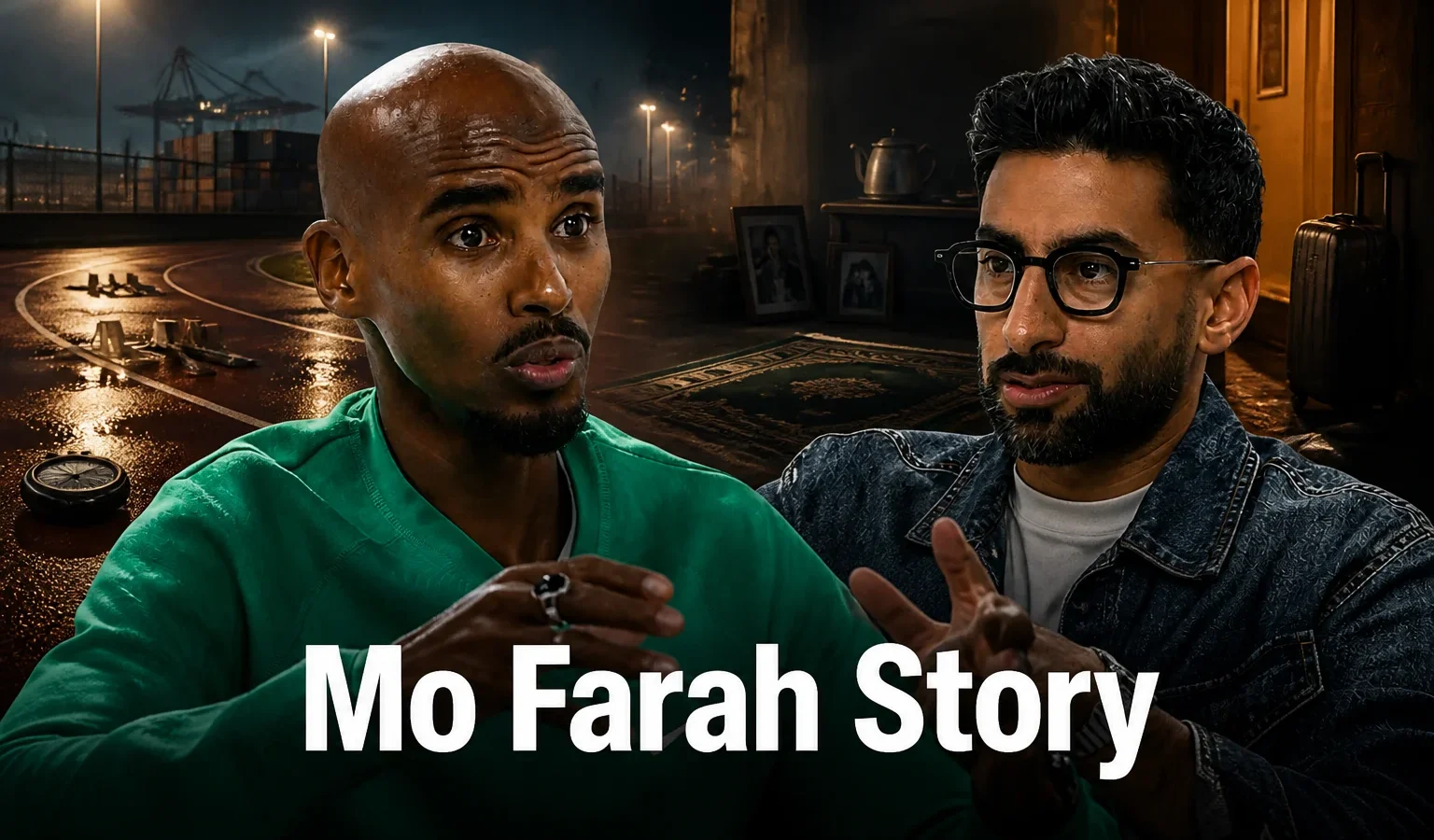
This article draws on our conversation with Sir Mo Farah.
He was nine when he landed in London and was told to answer to somebody else’s name. That single break sits underneath almost everything in Sir Mo Farah’s account: the child trafficking, the years of silence from home, the running, the family life he built later, and the faith he says carried him through it.
He says he is doing great now, living a quiet life in Doha, Qatar, and happiest around his children and the people he loves. That calm setting matters because the story he tells begins far from it, with war, separation, and a childhood lived under a false identity.
How did Sir Mo Farah get a different name?
Sir Mo Farah says the public name the world knows came from the identity he was forced to use when he was brought to the UK as a child. He explains that his birth name is Hussein Abdi Kahin, but he arrived under another child’s name, Mohammed Farah, after being told to answer to it when he came to London at nine (5:33).
“It’s not your name, Hussein.”
— Sir Mo Farah (21:41)
That sentence marks the point where a child’s real identity was pushed aside. The next line makes clear how complete that change became in daily life.
“Nobody ever calls me that.”
— Sir Mo Farah (21:44)
He also says his father was killed when war broke out when he was four years old, and that there were eight children in the family including him (3:11). Before London, he lived in Djibouti for two or three years. Those details explain why the name change was not a minor paperwork issue in his telling of it; it came inside a much larger story of conflict, loss, and displacement.
What stays with you is how ordinary the false name became on the surface, even though it covered something violent underneath. The world learned Mo Farah. He says the boy underneath that public name was Hussein Abdi Kahin.
Child trafficking turned his childhood into work and silence
Sir Mo Farah says he was child trafficked to the UK and then kept in a house doing domestic work instead of living anything like a normal childhood. He describes not going to school for close to a year, being cut off, and speaking to his mother for none of the 10 years after that separation.
The account is stark because it is practical, not abstract. He was in a house. He was expected to work. School did not begin straight away. Contact with home disappeared.
The change came through people at school once he did get there. He says school staff, and especially PE teacher Alan Watkinson, helped trigger social services’ involvement. In his telling, that was the moment adults around him started to see what was happening and acted on it.
This part of the story also explains why running matters later. Before medals or championships, sport gave him a place where somebody noticed him properly. The first rescue in his account is not phone or selection. It is being seen by people who understood that a child should be protected.
How did Sir Mo Farah reunite with his mother?
Sir Mo Farah says he found his way back to his mother after a woman located him with two physical traces from home: a cassette recording from his mother and a family photo. He says he had not spoken to his mother for 10 years, and then, within six months, he flew to see her (23:26).
He expected that first trip to last four weeks, but the stay became two months. The numbers matter because they show the distance between plan and feeling. A short visit turned into something longer once he was back with family.
There is no need to dress that up. A recorded voice and a photograph reopened a life that had been shut off from him. After a decade of separation, those objects connected a grown public figure to a child who had been cut away from his own home.
The reunion also sits next to the earlier silence in a way that changes how you read the whole story. The lost years do not disappear because a visit happens. They stay there. But he describes getting that time with his mother at last, and even the shift from four weeks to two months suggests how hard it was to leave once contact was restored.
Running gave him a route out
Sir Mo Farah says running carried him from local club races to the top level of the sport, but he describes that rise as built on work rather than talent alone. He recounts moving from club running to Middlesex, then England, then Great Britain, and later winning 4 Olympic medals (9:46).
His description of training is exact. He says he spent six months of the year training in the mountains, and at one stage was running 120 miles a week for 8 weeks. He also says he studied rivals closely, treating races as something to prepare for in detail rather than simply turn up and survive.
“That’s what it takes to be a champion.”
— Sir Mo Farah (41:37)
The line comes with a clear view of what elite sport demands from the rest of your life. The volume, the travel, and the attention to competitors all fit the same standard: nothing casual, nothing left to chance.
He ties that discipline to results as well. When he talks about the 2012 Olympics (39:23), he is not talking about a lucky fortnight. He is talking about years of structure, repeated sessions, and long stretches away from home that made those wins possible.
How small are the margins in elite distance running?
Sir Mo Farah says the difference at the top of distance running can be tiny enough to disappear into a stride or a decision made in a split second. He talks about elite racing in terms of fractions, including the idea that the gap can be 1% (42:39).
He gives the point shape with race detail. In one case, he describes losing a 5000 meters medal by less than 1/2 a second. In another, the question put to him frames one Olympic target as winning two medals (42:51), which helps show how thin the line is between a historic championships and a near miss.
That is why he says preparation has to reach beyond fitness. You have to know the field, watch the moves, and be ready for pace changes when tiredness makes people switch off. The margins are so small that one lapse can wipe out months of work.
His account of top-level racing never treats excellence as mysterious. It is measured in details, in repeated miles, in tactical awareness, and in the difference between reacting early and reacting late when the race finally opens up.
Family held while running took him away
Sir Mo Farah says his marriage worked because home stayed strong while elite sport kept him away for long stretches. He says he got married in 2010, and that his wife held the family together while he was away six months of the year because of training and racing.
He names the values directly: honesty, trust, love, and being Muslim. None of those appears in his account as a slogan. They sit inside daily strain, travel, and the practical question of how a family keeps shape when one parent is absent for so much of the year.
“You’re not having, you’re not going to have a lot of time.”
— Sir Mo Farah (1:24:07)
The sentence is about the cost of the schedule. Elite success takes hours from home, and he does not pretend otherwise. The answer he gives is not balance in the soft sense. It is clarity about what matters and gratitude for the person carrying more of the domestic load while he is away.
He connects that family life to faith as well, saying being Muslim is central to how he sees marriage and responsibility. In his account, family did not sit beside the running career as a separate compartment. It was one of the structures that allowed the career to continue at all.
Fatherhood, respect, and the faith that runs through everything
Sir Mo Farah says fatherhood changed how he saw himself because it brought him back down to earth and fixed his attention on the kind of person he wanted to be at home. He describes having children as the thing that made him less defined by racing and more aware of responsibility.
“It taught me to be grounded.”
— Sir Mo Farah (48:53)
From there, he moves to the lesson he would give any child: respect. He does not treat that as old-fashioned manners or a soft extra tagged onto success.
“If you have no respect for someone, no matter who you are, you’re not going anywhere.”
— Sir Mo Farah (1:05:15)
He also says faith runs through the whole story, from childhood survival to retirement. He speaks about gratitude, salah, and wanting to be remembered in a way that reflects more than medals. In that account, faith is not separate from the rest of his life. It sits with survival, with marriage, with fatherhood, and with the quieter life he says he now enjoys in Doha.
That leaves you with a picture of a man who measures his life in more than wins: a stolen childhood, a reclaimed family bond, years of hard running, and a belief that respect and faith have to hold the rest together.
Listen to the full episode
Listen to the full conversation on Spotify — the episode goes further than any article can, and following the show means you catch the next one.
 Watch this episode on YouTube ·
 Listen on Spotify · Subscribe to #ABtalks
Links from this episode
Mentioned in the episode. Some of these may be affiliate or sponsored links.