
Sir Mo Farah · · 5 min read
How Did Mo Farah Reunite With His Mother After 10 Years?
Read the Mo Farah reunion story, from the cassette tape to the first call and flight to see his mother. Get the full account now.
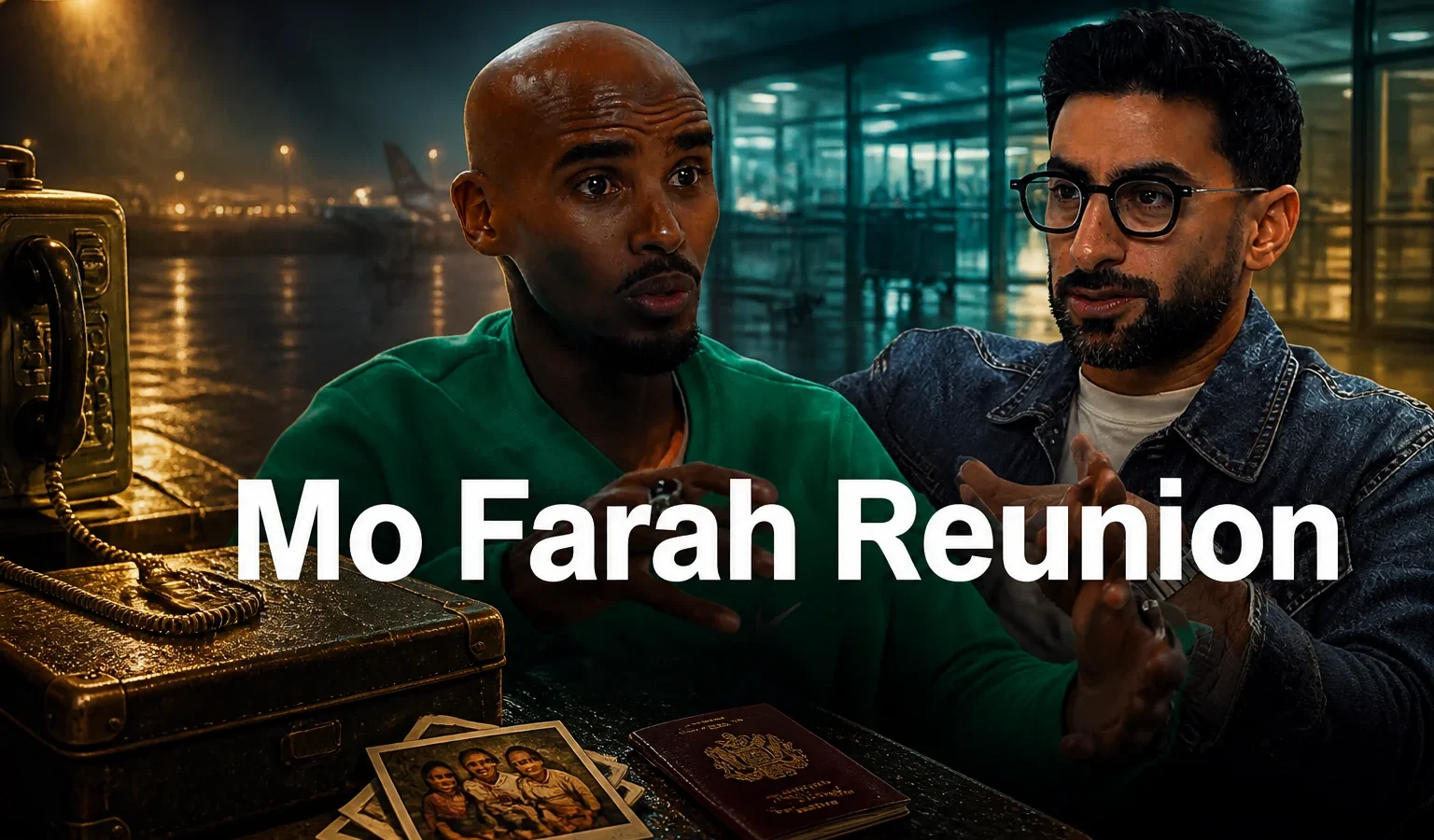
This article draws on our conversation with Sir Mo Farah.
For the Mo Farah reunion story, the short answer is simple: he got back to his mother after a woman returned from Somaliland with proof of who he was, a way to contact her, and the first real link he had carried in years.
Sir Mo Farah says he had not spoken to his mother for 10 years, and she did not know whether he was alive or dead (24:00). That gap is the whole weight of the reunion. It was not a neat family reconnection. It started with someone arriving with a cassette tape, a phone number, and a framed family picture that put names, faces, and memory back in front of him.
How did the reunion with his mother actually begin?
The reunion with his mother began when a woman traveled to Somaliland, found out there was a boy in the UK, and came back carrying his mother’s recorded voice, her phone number, and a family photo.
Farah describes a moment that turned on a name. The woman asked what he was called, then told him he was not Mohammed but Hussein. The exchange matters because it was the first time someone in front of him connected him back to the family he had been cut off from.
“It’s not your name, Hussein.”
— Sir Mo Farah (21:41)
That was followed by another line that stopped him cold.
“Nobody ever calls me that.”
— Sir Mo Farah (21:44)
He says he froze when she mentioned his mother because nobody had used that identity with him. Then she showed him a framed family picture and played the cassette. Hearing his mother’s voice and seeing the image changed the situation at once. He says he became excited because he learned his brothers were alive and okay. Up to that point, the separation had left him without even that basic certainty.
The details matter here because they show how fragile the connection was. This was not a message on a phone screen. It was one woman carrying physical proof across borders: a tape, a number, a photograph. That is how the path back opened.
How did Mo Farah speak to his mother after so long?
Mo Farah says speaking to his mother after so long meant using a formal phone-office system where you had to book the call in advance and wait for the connection at a set time.
He explains that you could not just ring directly. You had to call an office, make an appointment, and then wait until the scheduled moment arrived. He says he called on a Thursday, while his mother went first thing in the morning and waited outside the office all day for the afternoon call. That image does most of the work on its own: after years without contact, the first conversation depended on a timetable, a building, and her willingness to spend the day waiting for one chance to hear his voice.
Farah says she had spent 10 years without seeing him before they were reunited in person (19:50). The phone call came first, but even that was not instant or easy. It had to be arranged, held onto, and reached at the right hour.
If you want to understand why the reunion carried so much force, that practical detail explains it. Every step took effort. The woman had to bring the contact details back. He had to place the booking. His mother had to get to the office early and stay there until the line opened.
When did he finally see his mother again in person?
He says he flew to see his mother within six months, maybe even shorter, after making contact, and by then the separation had stretched across a full decade.
Farah says the trip happened within six months of that first reconnection (23:26). He traveled via Djibouti, expected to stay for four weeks, and then stayed for two months instead. The trip answered the title’s question in the most direct way possible: first came proof, then the phone call, then the flight.
Once he got there, the plan gave way to being with family. He says he did not do a single run while he was there. That detail strips away the public image for a moment. The visit was not about training, performance, or anything you know him for from the track. He had gone to see his mother after years in which she had no idea if he was alive.
He also says his brother now has 10 kids (25:03), which places the reunion inside a larger family life that had kept moving while he was away. By the time he arrived, he was not stepping back into a frozen memory. He was meeting a family that had grown, changed, and survived the years apart.
Listen to the full episode
Listen to the full conversation on Spotify — the episode goes further than any article can, and following the show means you catch the next one.
 Watch this episode on YouTube ·
 Listen on Spotify · Subscribe to #ABtalks
Links from this episode
Mentioned in the episode. Some of these may be affiliate or sponsored links.