
Sir Mo Farah · · 4 min read
How Was Mo Farah Trafficked to the UK as a Child?
Read how Mo Farah trafficking happened, from the false identity to life in the first London home. Get the full story now.
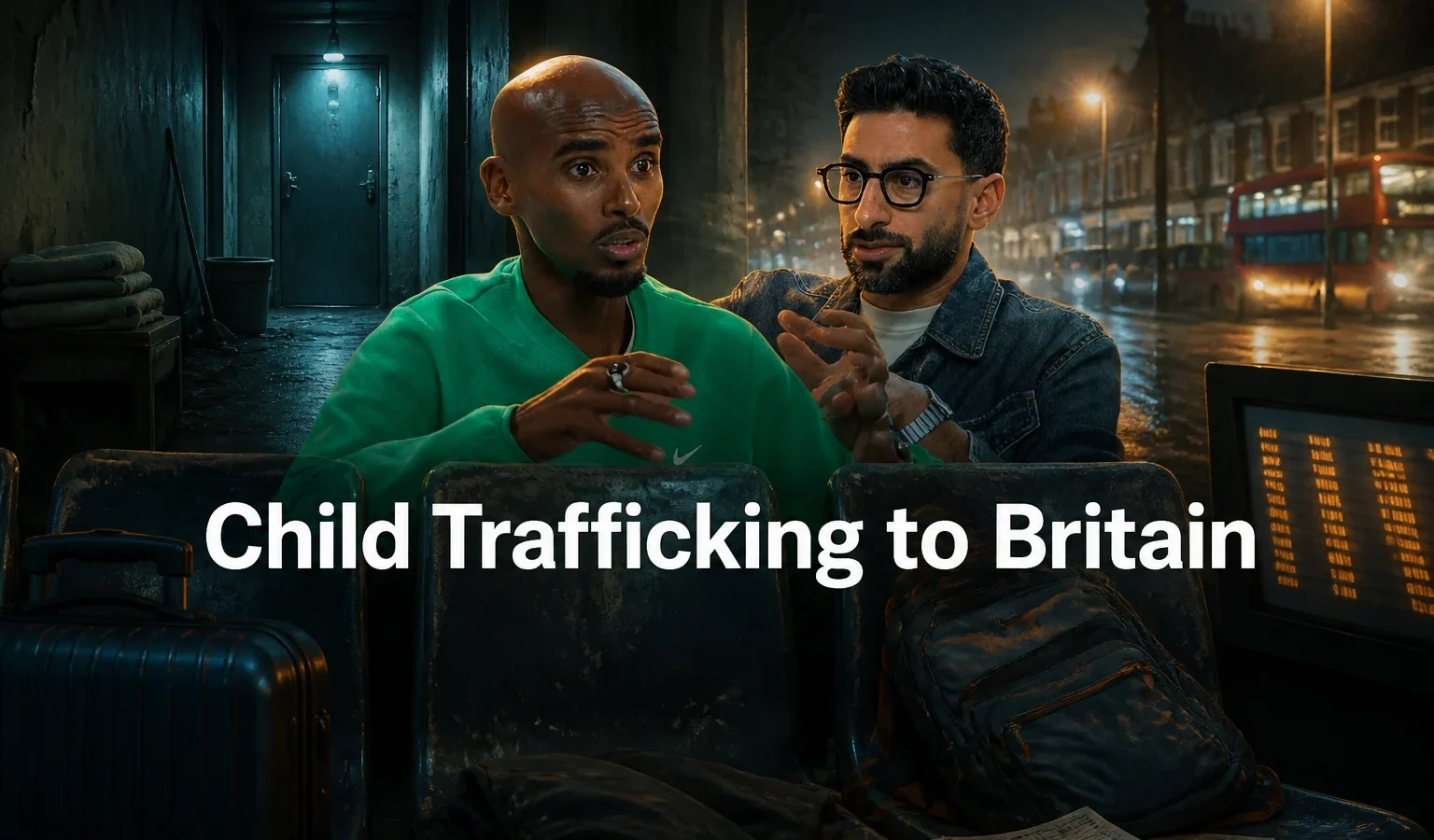
This article draws on our conversation with Sir Mo Farah.
A boy is told his name has changed, handed a story to repeat, and put on a plane. That is how Sir Mo Farah describes the start of the child trafficking that brought him to Britain.
Farah says his father was killed when he was four years old (3:11). After that, the family was displaced, and he later lived in Djibouti with an aunt for two or three years before the journey that changed everything.
He says the trip began with a false name and a false family story
Farah says the journey to Britain was arranged around a lie he was expected to carry. About a week before travel, he says, a woman told him that if anyone asked, his name was Mohammed Farah and that another child travelling with him was his brother.
He says he arrived in London at nine, expecting relatives to meet him (5:33). Instead, the woman who brought him took his papers and warned him not to talk. Looking back, he says he now understands that he had been child trafficked into the UK and given a different identity.
That sequence matters because it is the clearest answer to the question in the title. In Farah’s account, the move to Britain did not begin as a family reunion or a straightforward relocation. He describes a child being coached in what to say, separated from his own documents, and placed under the control of an adult who kept him silent.
Farah also fixes the period in time. He says he came in 93 (27:46), which places the trip and the first stage of his life in Britain in the early 1990s, before he was old enough to understand what had been done to him.
What happened after Mo Farah arrived in the UK?
After arriving in Britain, Farah says he was put to work inside the house and treated as a child under control rather than a child being cared for. He describes doing everything for the children there: cooking, cleaning, changing diapers, looking after them, and running home from school to pick them up.
He says he did not go to school for close to a year at first (7:08). In his telling, that first stretch in London was not only isolating but also practical confinement, because school is where a child meets other adults, other children, and people who might ask questions. Without that, the house became the whole world.
Farah describes the situation as emotionally and physically very difficult. He is also specific about the kind of abuse he says he suffered: physical, not sexual. That distinction comes from him, and he keeps the account focused on control, fear, housework, and violence.
He says the first family kept him for a year, a year and a half, possibly closer to two years, after he arrived (27:37). The exact length, in his own account, carries some uncertainty, but the core fact does not. He says he spent a long period in that first home under the authority of adults who had brought him into the country under a false identity.
How Farah explains it now
Farah explains the child trafficking story in direct hindsight: as a child, he did not fully grasp what was happening, but as an adult he now names it for what it was. He says he was brought into the UK under another identity and made to live in a house where he served the family.
The earlier parts of his story fit together in the way he tells them. His father’s death set off the instability that followed. Living in Djibouti with an aunt came before the trip. Then came the instruction to use a different name, the flight to London, the removal of his papers, and the warning not to speak.
Farah does not pad the account with grand language. He keeps returning to concrete things a child would remember: who told him what to say, what he expected at the airport, what work he had to do in the house, and how hard that period felt day to day.
One family detail appears later in the same stretch of conversation and shows how separated life had become. He says his brother now has 10 kids (25:03). He is not using that number to explain the trafficking itself, but it places his childhood story inside a real family that continued on without him while he was living under another name in Britain.
Listen to the full episode
Listen to the full conversation on Spotify — the episode goes further than any article can, and following the show means you catch the next one.
 Watch this episode on YouTube ·
 Listen on Spotify · Subscribe to #ABtalks
Links from this episode
Mentioned in the episode. Some of these may be affiliate or sponsored links.