
Sir Mo Farah · · 4 min read
What Lesson Would Mo Farah Teach Every Child?
Discover Mo Farah’s respect lesson for every child and why simple words like please and thank you matter. Read the full lesson now.
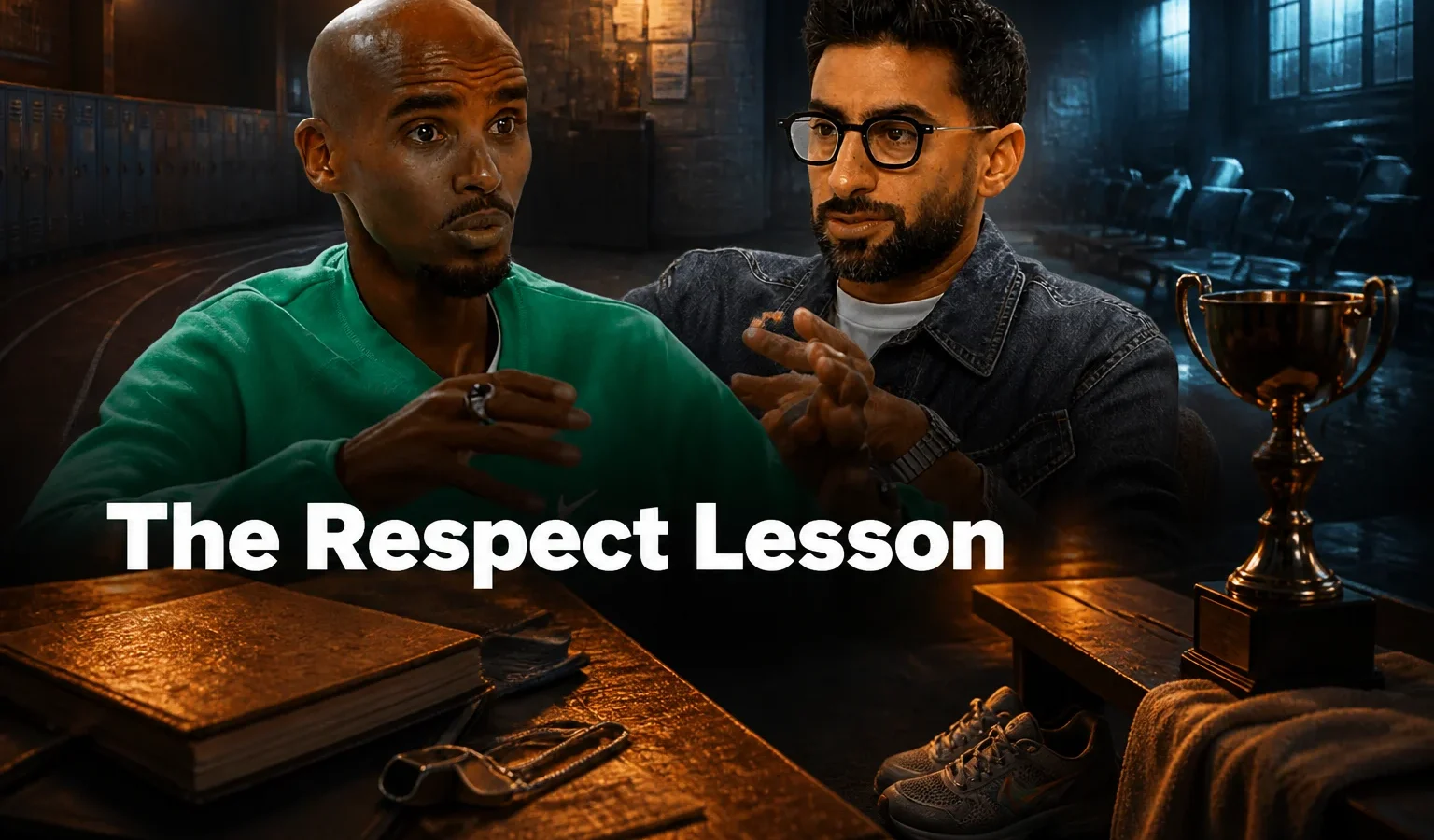
This article draws on our conversation with Sir Mo Farah.
One answer came fast: the respect lesson Sir Mo Farah would give every child is simple enough to fit into two words and hard enough to shape a whole life.
He does not dress it up as a slogan. He says he would teach respect, and he ties that choice to family, to his mother, and to the people he met through his father early in life.
Why respect comes first
Respect comes first, in Farah’s account, because everything else falls apart without it. He does not present it as good manners for show or as a polished extra for successful people. He presents it as the base layer of character, the thing that decides how far you can really go with other people.
“If you have no respect for someone, no matter who you are, you’re not going anywhere.”
— Sir Mo Farah (1:05:15)
That is the lesson in its clearest form. He links it to ordinary behavior, not grand speeches. Saying thank you. Saying please. Meeting people without treating them as beneath you. In his telling, respect is not expensive, rare, or complicated. It costs nothing, which makes the failure to give it harder to excuse.
Farah also roots the idea in where it came from. He says this value came from his family, from his mother, and from the people around his father early in life. That matters because he is not describing a lesson he picked up after medals or phone. He is describing something older than success, something learned before public recognition ever entered the picture.
If you are looking for one practical rule inside the respect lesson, it is this: treat people properly before you decide whether they can do anything for you. His version of respect starts in the small moments most people rush past.
How Mo Farah’s respect lesson survived success
Mo Farah’s respect lesson survived success because, by his own account, success did not replace his values. He says his values have not honestly changed, even after a life marked by loss, displacement, mistreatment, and then extraordinary achievement.
That wider arc gives the lesson its weight. A person can talk about respect from comfort and still sound convincing, but Farah speaks about it after a childhood that gave him plenty of reasons to harden. He does not describe respect as naivety. He describes it as a standard he kept.
He also makes a distinction between values changing and values becoming more visible. He says that 10 years ago he would not have had this kind of open conversation (1:06:32). In the same exchange, the question put to him frames the comparison across 10 years (1:06:45). The point is not that respect arrived late. The point is that maturity made him speak more plainly about what was already there.
That helps explain why retirement appears in this part of the conversation. He says that since retiring, he gives more time to what he believes in, including religion, Hajj with his wife, and the causes he supports. The values are the same; the time and openness around them have grown.
So the lesson does not sit apart from the rest of his life. It runs through it. The child shaped by family, the man who faced mistreatment, and the public figure after retirement are not offered as different moral versions of the same person.
What does Mo Farah want children to learn about respect?
Mo Farah wants children to learn that respect is basic conduct you choose every day, not a lofty principle you save for special moments. His answer stays concrete: speak properly, acknowledge people, and do not act as if status gives you permission to dismiss them.
That is why the smallest examples in his answer matter. Thank you and please are easy to overlook because they sound ordinary. He uses that ordinariness to make the point sharper. If respect costs nothing, then children can practice it now, without waiting for age, money, confidence, or authority.
Anas Bukhash offers a brief human note in the same stretch of conversation when he says:
“Habibi, you’re OK, don’t worry.”
— Anas Bukhash (1:03:47)
The exchange sits inside a more open part of the discussion, where Farah acknowledges that he would not have spoken this way years earlier. What comes through is not a new code but a clearer statement of an old one: respect begins in the home, shows up in simple words, and stays in place if your values are real.
For a child, that makes the lesson usable. You do not need a big stage to live it out. You need the next conversation, the next disagreement, the next chance to show another person they matter.
Listen to the full episode
Listen to the full conversation on Spotify — the episode goes further than any article can, and following the show means you catch the next one.
 Watch this episode on YouTube ·
 Listen on Spotify · Subscribe to #ABtalks
Links from this episode
Mentioned in the episode. Some of these may be affiliate or sponsored links.