
Sir Mo Farah · · 5 min read
How Does Mo Farah Describe the Role of Faith in His Life?
See how Mo Farah faith shapes survival, family, prayer, and gratitude in his own words. Read the key lessons now.
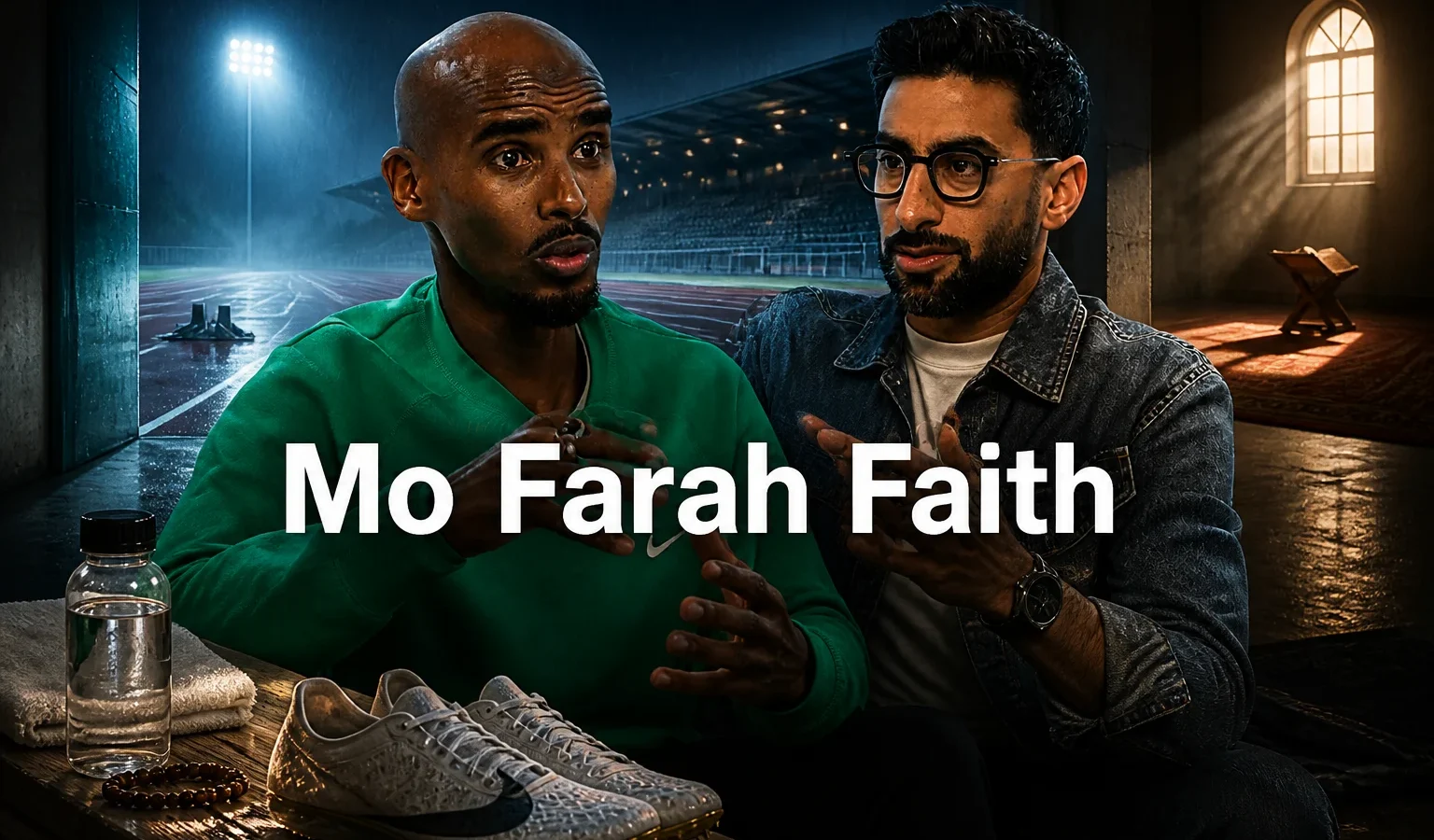
This article draws on our conversation with Sir Mo Farah.
He doesn’t circle around it. Asked to describe himself in one word, Farah answers with Mo Farah faith in the plainest possible way: faith.
Sir Mo Farah ties that answer to survival, gratitude, family, and the way he understands his own story. He does not present belief as a side note to success. He describes it as the thing that helped him endure childhood pain, make sense of what followed, and decide what matters now that running no longer takes every hour of the day.
Why does faith sit at the center of how Farah sees his life?
Faith sits at the center because Farah says it is what carried him through the worst parts of his life and what lets him read his story without losing himself in it.
He says he never gave up as a child. He questioned things. He cried. But he also says he always had faith, and he kept believing that if Allah meant something for him, it would come one day. That is not presented as a polished lesson after the fact. He describes it as the way he got through the days when he did not have answers.
He also says he sees his life as sliding doors, with many events needing to line up. That image matters. It turns his story away from control and toward meaning. He does not describe every outcome as something he engineered. He describes a chain of moments that only makes sense to him through Iman and belief.
When he talks that way, faith is not only comfort. It is also interpretation. It gives him a way to understand why his life took the path it did, and why survival did not harden into despair. In his account, belief is what stops suffering from being the final word.
That thread also answers why the word he chooses for himself is so revealing. He could have picked runner, father, husband, survivor, or champion. Instead, he picks the thing underneath all of them.
Has Farah’s faith changed over time?
Farah says his values have not changed, but retirement has given him more time to live those values more fully.
When he is asked how his values have changed across 10 years, he says they have not changed in substance, but his life now gives him more room for what he believes in (1:06:45). That distinction is worth holding onto. He is not describing a new identity after sport. He is describing the same core beliefs with a different schedule around them.
The practical examples he gives are specific. He mentions Hajj with his wife. He mentions religion directly. He mentions the causes and encouragement he wants to put his energy into. So the shift is not from belief to belief. It is from a career structured around training and competition to a life with more space for worship, reflection, and the duties he feels toward other people.
That makes his Mo Farah faith answer less abstract than it first sounds. He is not using faith as a vague label for optimism. He ties it to acts, commitments, and time. Retirement, in his telling, has not replaced one mission with another. It has let him give more attention to parts of life that elite sport left less room for.
He also keeps the frame narrow. He does not claim that achievement proved belief true. He says belief stayed with him before, during, and after achievement. The order matters.
What does Farah want his children and loved ones to hold on to?
Farah wants the people closest to him to hold on to love, gratitude, prayer, and constant remembrance of Allah.
“Just tell them you love them and always have faith, don’t ever forget Allah, who created us for us.”
— Sir Mo Farah (1:24:51)
He places faith inside family life, not outside it. He says he wants to keep that with his children, which makes religion part of inheritance as he understands it. Not medals. Not public reputation. A way of living.
He also links belief to urgency. Life is short in the way he talks about it, and that is why worship cannot be postponed.
“You’re not having, you’re not going to have a lot of time.”
— Sir Mo Farah (1:24:07)
From there, he turns to conduct: stay grateful, stay on top of salah, and do not assume there will always be another chance to fix what you have neglected.
“Just live your life as is your last.”
— Sir Mo Farah (1:25:29)
He keeps pressing the same point from another angle.
“Again, how long for do we know?”
— Sir Mo Farah (1:26:03)
That is where Farah leaves the subject. Faith, in his account, is not only what helped him survive the past. It is what tells you how to use the time you have left now.
Listen to the full episode
Listen to the full conversation on Spotify — the episode goes further than any article can, and following the show means you catch the next one.
 Watch this episode on YouTube ·
 Listen on Spotify · Subscribe to #ABtalks
Links from this episode
Mentioned in the episode. Some of these may be affiliate or sponsored links.