
Yo Yo Honey Singh · · 4 min read
Why Was Yo Yo Honey Singh Not Happy at His Peak?
Peak unhappiness explains why Yo Yo Honey Singh says fame, money, and hits did not bring peace. Read the full story now.
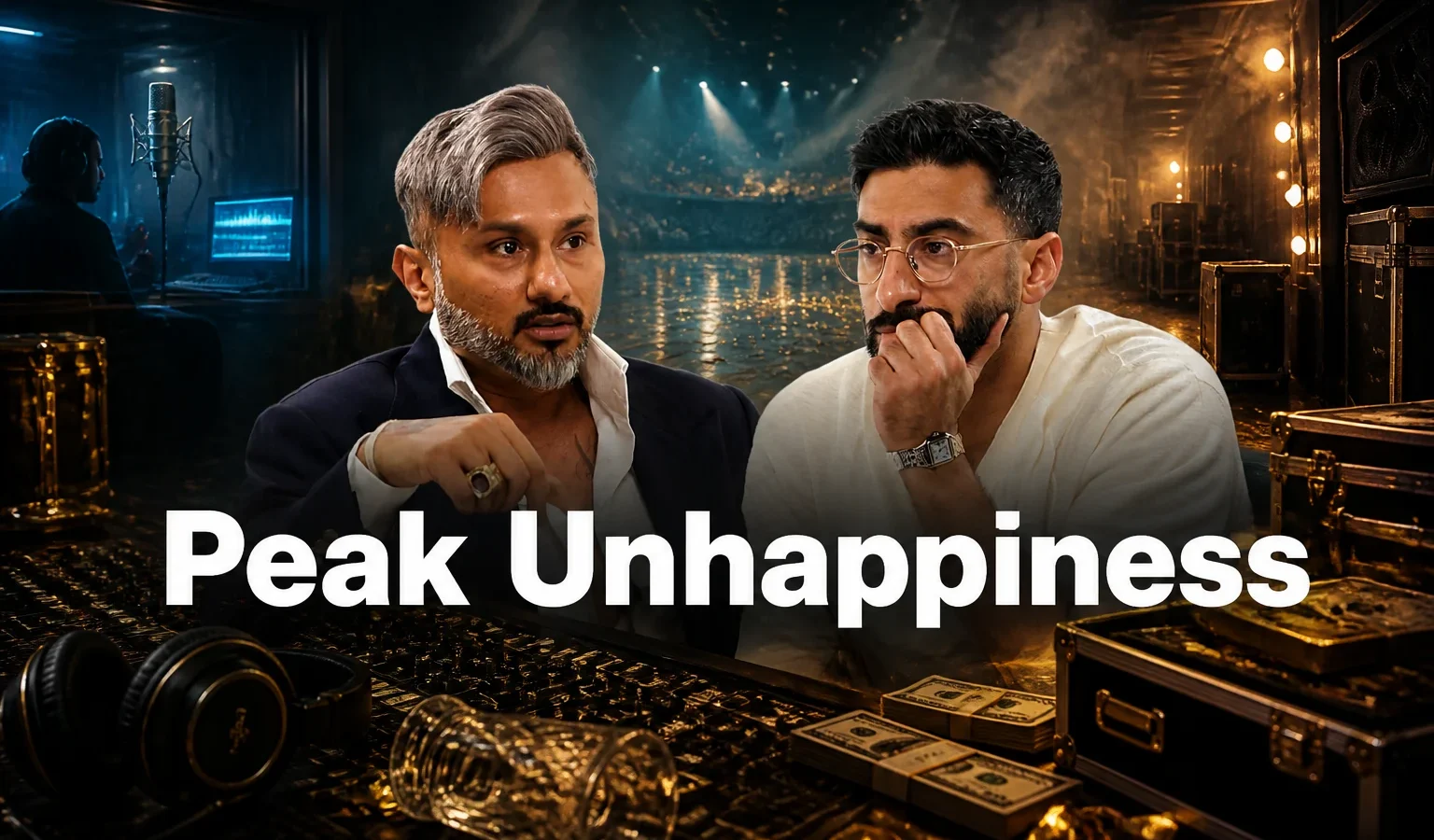
This article draws on our conversation with Yo Yo Honey Singh.
At the height of his fame, Yo Yo Honey Singh says he was living the opposite of a happy life. The answer he gives is harsh and specific: the hits were real, the money was real, the public demand was real, but inside he says he was angry, arrogant, unstable, and spiritually empty.
He places that collapse right in the years people usually romanticize. Yo Yo Honey Singh says that in 2012, eleven and 14, he was at his peak and not in his senses (30:14). That detail matters because it turns the usual story upside down. From the outside, you saw a star. From his own account, the inside looked closer to a breakdown already in motion.
His unhappiness started long before the peak
His unhappiness at the top, Singh says, did not begin with success; it began much earlier with anger that had been building since childhood. He links that anger to inferiority and humiliation, and he describes fame not as a cure for those feelings but as an amplifier that made them bigger, louder, and more dangerous.
In his account, old wounds did not disappear when the career exploded. They stayed in place and then mixed with scale. Once the songs became massive and his name became unavoidable, the insecurity underneath did not calm down. It hardened. He says that by then he had become arrogant and destructive, which makes his explanation of celebrity unhappiness very plain: if the emotional damage is already there, public success gives it power rather than peace.
That also explains why the outside picture can fool people. You can have songs everywhere, constant attention, and the kind of recognition most people chase for years, yet still carry the same unresolved pain that shaped you earlier. Singh ties his worst period to that exact split between what people saw and what he was actually living. The applause did not settle the anger. It sat on top of it.
Why did Yo Yo Honey Singh feel unhappy at his peak?
Yo Yo Honey Singh says he felt unhappy at his peak because fame fed his ego, deepened his self-destruction, and left him believing his own power was absolute. He describes a period in which he disrespected everybody, thought he alone had made everything happen, and even called himself God.
“You may not going to get the second chance.”
— Yo Yo Honey Singh (31:54)
The line fits the way he talks about that phase of his life: not as glamorous excess, but as a dangerous state in which he had stopped seeing reality clearly. He says he was doing drugs and living in what he calls a demonic state of mind. That is not a side note in his explanation. It is central to it. In his telling, ego and substance use did not sit beside success as separate issues; they became part of the machinery that made success miserable.
He also draws a sharp contrast between public image and private condition. Publicly, he had massive songs. Privately, he says he was unstable and spiritually empty. That contrast is the article’s real answer. Celebrity looked like control from the outside, but he describes losing control of himself. The scale of his fame made the illusion stronger. If everyone around you is cheering, it gets easier to believe you are untouchable. His account says the opposite was true.
Money and hit songs did not protect him
Money did not protect him from collapse because, by his own telling, commercial success kept going even while his life was falling apart. Singh says royalty income continued while he was away because people kept playing his songs and missing him, which shows how little financial reward can do once a person is already breaking down.
That detail cuts through a common fantasy about celebrity. People often assume the unhappiness ends once the numbers are big enough, once the songs are big enough, or once the public loves you loudly enough. His account says no. The audience stayed. The songs stayed in rotation. The income continued. None of that stopped the crash.
He now describes success in completely different terms. Success, he says, is no longer about money or how many hits he can deliver. He speaks about it instead as a statement and something symbolic that will stay forever. That shift matters because it answers the deeper question underneath celebrity unhappiness: what happens when achievement gives you scale but no meaning. In his version, the earlier definition of success left room for ego, anger, and self-destruction. The later definition tries to outlast all three.
Listen to the full episode
Listen to the full conversation on Spotify — the episode goes further than any article can, and following the show means you catch the next one.
 Watch this episode on YouTube ·
 Listen on Spotify · Subscribe to #ABtalks
Links from this episode
Mentioned in the episode. Some of these may be affiliate or sponsored links.