
Yo Yo Honey Singh · · 5 min read
How Did Faith Change Yo Yo Honey Singh’s Life After His Breakdown?
See how Honey Singh faith reshaped his life after illness, surrender, and recovery. Read the story behind his spiritual turning point.
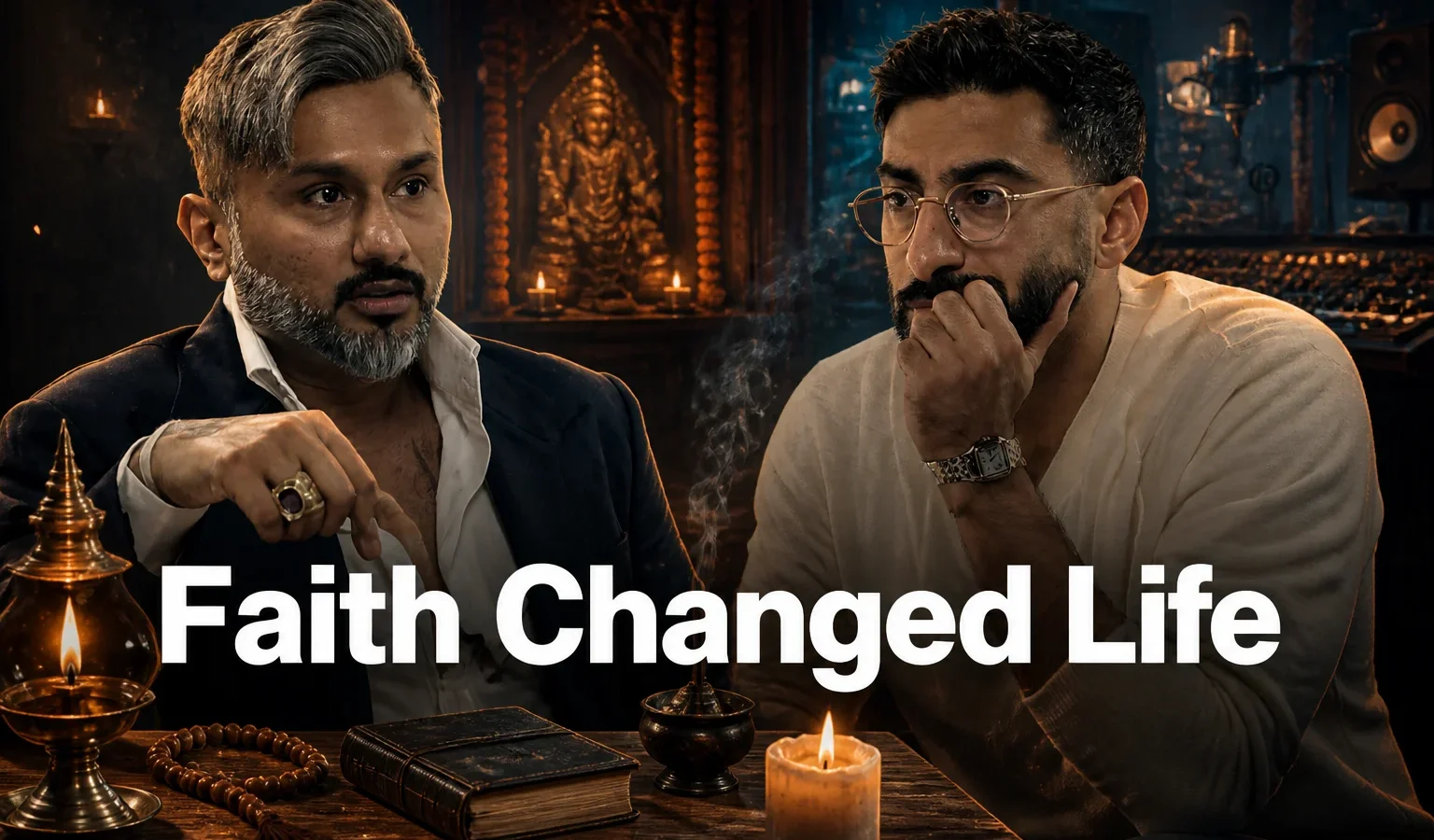
This article draws on our conversation with Yo Yo Honey Singh.
Yo Yo Honey Singh says Honey Singh faith began for him on a night in 2019 when he stopped fighting, surrendered to God, and asked to die. Until then, he says he had been a non-believer through the worst stretch of his illness, but the shift from atheism to belief changed how he explains his life, his recovery, and his future.
He says he was sick for seven years (0:48), and he frames that period less as a blank loss than as the place where his thinking broke and was rebuilt. That matters because he does not describe belief as a side note after recovery. He describes it as the thing that reordered everything else.
The night he says God gave him a reason to stay
Yo Yo Honey Singh says the turning point came in 2019, when he surrendered completely and asked God for death instead of relief (4:48). He describes that night as the break between two lives: the one in which he did not believe, and the one in which he began connecting everything back to God.
“I didn’t got the death, I got the purpose to live.”
— Yo Yo Honey Singh (4:43)
He does not present that moment as a vague spiritual mood. He treats it as a direct answer to a direct plea. In his telling, he asked for the end, and what came back was a reason to continue. That is the core of his religious framing now: not that life became easy, but that it became assigned.
From there, he says belief changed the way he understands his comeback. He gives God the credit not only for survival, but for the practical pieces people usually describe as personal grit. Effort, discipline, thoughts, and strength, he says, all come from God when a person is truly in sync with him. In that view, recovery is not a private act of will. It is alignment.
That also explains why Honey Singh does not split his life into career on one side and faith on the other. He links the two. The return of work, routine, and direction sits inside the same explanation: God did it, and he sees himself as someone receiving that help rather than generating it alone.
Why he does not call those years wasted
Honey Singh says those years do not feel like a pure loss to him, even after everything they cost. When Speaker 1 raises the fear of falling back after seven years (48:58), Singh answers from a different frame: he says he came out of the ordeal like someone stepping out of a sauna, stripped down and cleared out rather than simply robbed.
That image matters because it shows how he now reads suffering through belief. He is not saying the period was pleasant or minor. He is saying it burned through something and left him with a cleaner sense of life. In his account, faith did not erase the pain; faith changed what the pain meant.
He ties that to timing too. Honey Singh says he is grateful the lesson came in his early 30s rather than in his 50s (49:23), because he still had time to rebuild both his life and his career. That gratitude sits right beside his religious language. He does not describe survival as accidental timing or luck. He thanks God for when it happened as much as for the fact that he came through it.
Seen that way, belief gave him a new calendar. The years are no longer counted only as what disappeared. They are counted as what prepared him for the life he thinks he still has time to build.
What faith looks like in his life now
Honey Singh says belief now gives him a sense of second birth, completeness, and a much smaller list of desires. He does not talk like someone still searching in every direction. He talks like someone who thinks the main search has already ended.
“I’ve got a second chance in life, second birth.”
— Yo Yo Honey Singh (0:42)
That line explains the scale of the change better than any label could. He is not describing a correction or a comeback alone. He is describing a new life. The spiritual shift sits at the center of that language, because the person speaking now is not the atheist he says he was during the darkest part of his illness.
“Everything is green for me now.”
— Yo Yo Honey Singh (12:46)
He uses that present-tense sense of wholeness to explain why he is not chasing much anymore. He says he feels complete, and the one thing he still longs for is children. Even that desire fits the broader way he now talks about life: less hunger for external proof, less restlessness, more acceptance of what comes from God and what does not.
So if you ask how faith changed Yo Yo Honey Singh’s life after his breakdown, his own answer is simple in structure even if it came through years of pain. He says he moved from disbelief to surrender, from asking for death to being given purpose, and from seeing himself as ruined to seeing himself as someone granted another life.
Listen to the full episode
Listen to the full conversation on Spotify — the episode goes further than any article can, and following the show means you catch the next one.
 Watch this episode on YouTube ·
 Listen on Spotify · Subscribe to #ABtalks
Links from this episode
Mentioned in the episode. Some of these may be affiliate or sponsored links.