
The Wizard Liz · · 4 min read
How The Wizard Liz Thinks Women and Men Enable Harm Differently
See how Enabled Harm works in Liz’s argument about men, women, and complicity. Read the breakdown now.
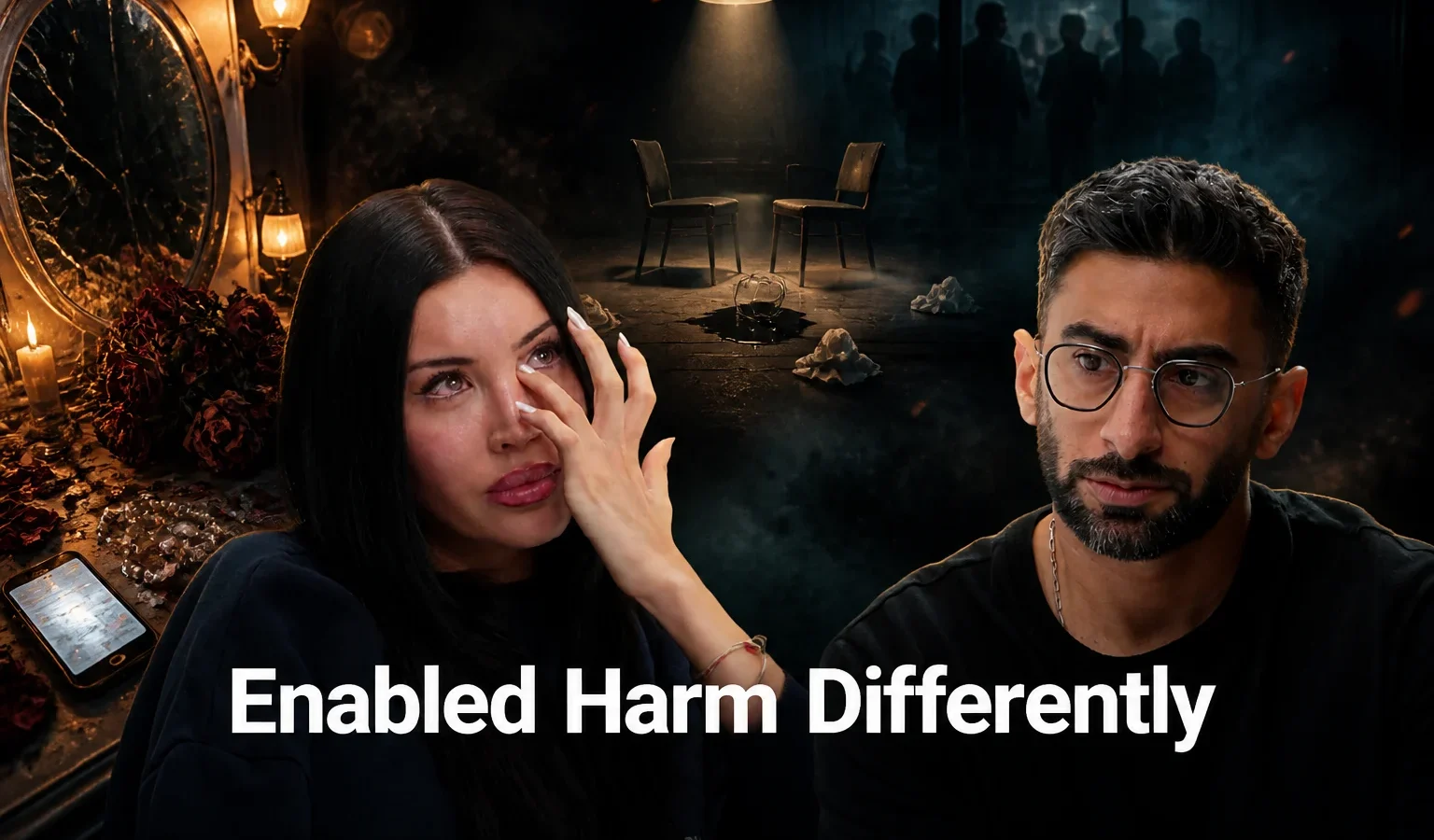
This article draws on our conversation with Liza Jubrailova.
Liz’s argument about enabled harm is that violence does not move through men alone; in her telling, women often direct, encourage, or sustain it from a different position. Liza Jubrailova builds that point around one image she says stayed with her after watching a Marina Abramović performance on YouTube: a woman standing still while the public was told they could do whatever they wanted.
Jubrailova does not treat that scene as an art review. She treats it as a lesson about complicity, power, and the way cruelty spreads once one person acts and another person permits, suggests, or quietly enjoys what follows.
Why does Liza Jubrailova say harm is not carried by men alone?
Liza Jubrailova says harm is not carried by men alone because, in her view, women often help set it in motion even when they are not the ones using direct force. Her example is Marina Abramović’s performance piece: a woman stood still with objects laid out for the audience, including roses and a knife, and the public was told they could do whatever they wanted to her.
“You can do anything to me, as you choose to the public.”
— Liza Jubrailova (2:11:58)
Jubrailova describes the crowd starting softly. People drew on Abramović’s body. Someone offered a rose. Someone offered chocolate. Then the mood changed. People cut her clothes, touched her breasts, and one person cut her badly in the neck while she stayed still (2:11:58).
Her reading of the scene is not limited to the obvious fact that male violence appeared in public. She says the uglier lesson is broader than that. In her account, women were present not as innocent bystanders but as participants of another kind, feeding the aggression without always carrying it out with their own hands.
That distinction matters to her because it changes where blame sits. A person can enable degradation by instructing it, approving it, or standing close enough to steer it while keeping their own image clean.
What did Marina Abramović’s performance show Liz about women enabling harm?
Marina Abramović’s performance showed Jubrailova what she sees as a split form of cruelty: one person commits the act, while another person whispers, nudges, and legitimizes it. She says women in that crowd were as bad in another way because they stood in the men’s ears telling them what to do to Abramović while not doing it themselves.
That is the center of her interpretation. She is not arguing that women and men express power in the same style. She is saying they can work together inside the same harmful event, with different jobs. In that frame, the man becomes the visible actor and the woman becomes the hidden director, and both are part of the damage.
Jubrailova stretches that reading beyond the performance into everyday life. She says a lot of women are ruling. She even says you could call it a matriarchy, because many men who appear powerful still have a woman in their ear shaping what they do. Her point is not about official titles. It is about influence that sits behind the person who takes the public action.
She applies the same idea inside families. In her account, a household can look male-led from the outside while the woman rules the emotional or practical center and the man acts out the harm. That does not remove responsibility from the man. It widens responsibility to include the person steering, rewarding, or encouraging what happens.
Why does Liz warn successful women to watch both men and women?
Jubrailova warns successful women to watch both men and women because, in her view, attacks do not come from one side only. A woman who assumes danger has one face misses half the room.
Her point follows directly from the Abramović example and from her wider reading of families and power. If harm can be direct from one side and guided from another, then a woman who is visible, admired, or advancing has to read both forms. One threat is open and physical. The other can be social, strategic, or intimate, arriving through jealousy, suggestion, pressure, or manipulation.
She does not present women as naturally safer or men as the only source of damage. She presents complicity as mixed. A woman can become the target of a man’s action and another woman’s encouragement at the same time. In her framing, that is why successful women need a wider sense of caution: not fear of everyone, but clarity about how power actually moves around them.
So the warning she leaves is simple in her terms. Do not sort people into safe and unsafe by gender alone. Look at who acts, who approves, who directs, and who benefits when somebody else gets hurt.
Listen to the full episode
Listen to the full conversation on Spotify — the episode goes further than any article can, and following the show means you catch the next one.
 Watch this episode on YouTube ·
 Listen on Spotify · Subscribe to #ABtalks
Links from this episode
Mentioned in the episode. Some of these may be affiliate or sponsored links.