
Yo Yo Honey Singh · · 5 min read
What Does Success Mean to Yo Yo Honey Singh Now?
See how Honey Singh success meaning changed from money to legacy, family, and artist power. Read the full story now.
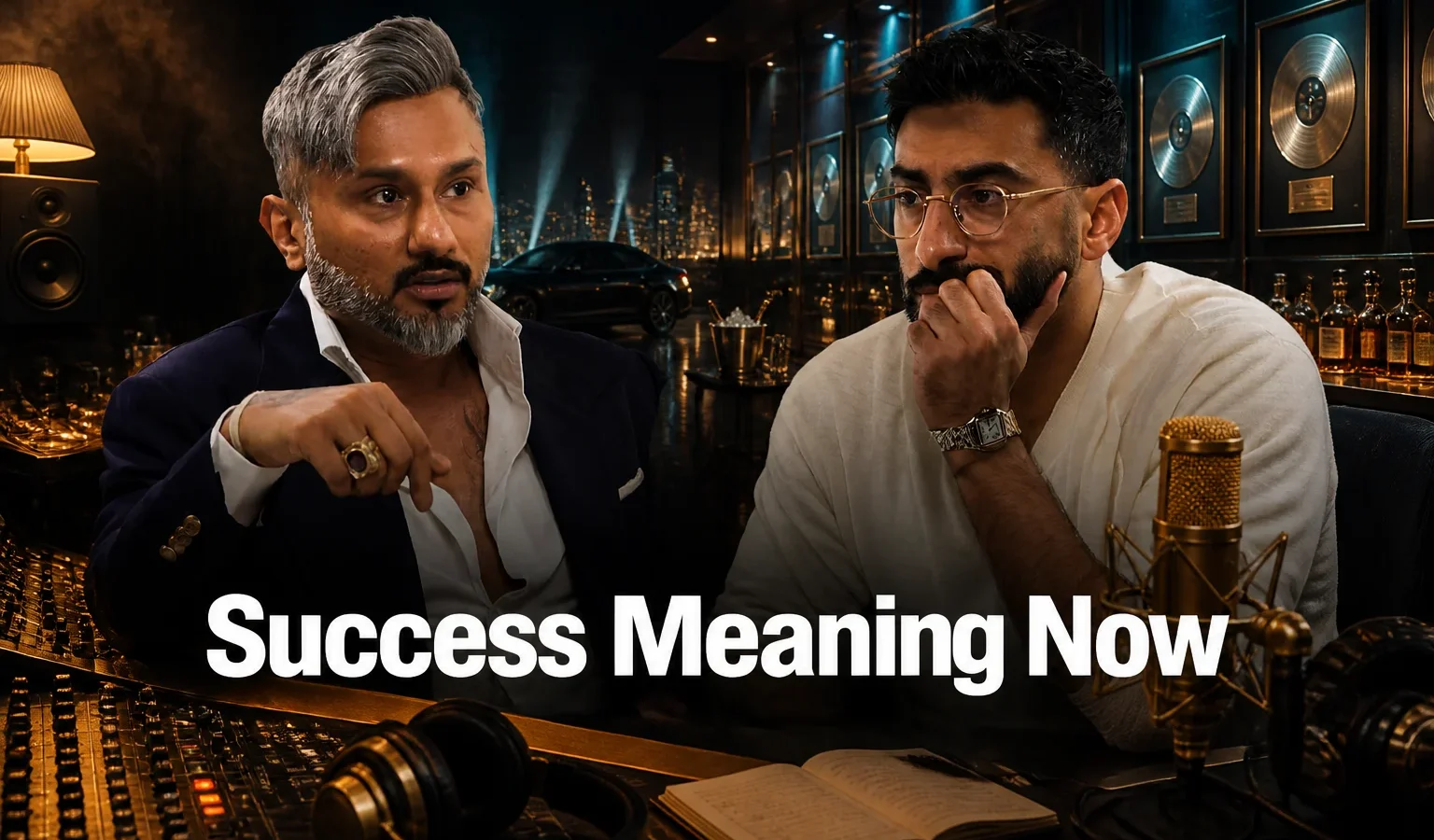
This article draws on our conversation with Yo Yo Honey Singh.
The numbers used to be easy: hit songs, money, demand. Now success for Honey Singh sits somewhere else entirely. He says the measure has shifted from how much he can earn or how many chart-toppers he can deliver to something that stays behind him, a statement people can still see long after the rush is over.
That change shows up in the choices he describes now. A month back, he says, he and his manager decided not to work with labels and to build their own instead (1:13:56). The plan is not framed as a business expansion. He presents it as a different idea of what winning looks like after illness, fame, collapse, and return.
Success now means leaving a mark, not stacking more money
Success meaning for Honey Singh has changed from accumulation to permanence. He says he no longer sees success as money or as proving he can keep supplying hits; he talks about it as a statement, something symbolic that remains.
That is a sharp turn in priorities. The ambition is still large, but the object has changed. Instead of chasing the next confirmation from the market, he speaks about building work and structures that outlast the moment. In his own account, the comeback is not only about being visible again. It is about making the second phase count for something bigger than numbers.
You can hear that change in how he talks about completeness. He says he is no longer searching for anything except children, and otherwise life feels complete. That matters because it moves success away from hunger without end. The old version keeps asking for the next song, the next cheque, the next proof. The version he describes now asks what remains once the applause dies down.
“Death is the biggest promise and is the reality.”
— Yo Yo Honey Singh (1:11:45)
Placed next to his idea of success, that line explains the scale he is using. If death is the fixed point, then money cannot be the final scorecard. A symbolic act can. So can family. So can something that changes the path for younger artists who come after him.
Why is Honey Singh starting his own label now?
Honey Singh says the new label is part of his present idea of success because he wants to build something for artists, not just sell his own songs. He says he and his manager decided a month back not to work with labels and instead create what he describes as India’s first artist-made music label (1:13:56).
He draws a clear line between labels started by businessmen and a label built by an artist. In his telling, businessmen-led labels exploit artists because they do not understand them in the first place. His alternative is rooted in lived experience: a musician building a company around what artists actually need, from creative respect to long-term development.
He also makes the scale of the idea plain. The goal, he says, is to launch lots of new talent. He compares the model to Hollywood artists such as Jay-Z building labels that create new superstars. The point is not simply independence for himself. The point is to open a route for other people.
He describes that as the first time this kind of artist-led label is happening in India (1:14:53). Whether you look at it as a business move or a cultural one, he presents it as legacy work. Success meaning here is tied to artist empowerment: if he can create a system that understands artists rather than using them, that becomes a more lasting achievement than another personal hit.
Family now sits where ambition used to sit
Family has moved to the centre of Honey Singh’s idea of a successful life. Asked to imagine limited time, he says that if he knew he would die in three years, he would stop making money, make more music, spend more time with family, and quickly have kids (29:05).
That answer pulls his priorities into focus fast. Money drops out first. Music stays, but not as hustle or scoreboard; it stays as something he still wants to make. Family comes forward with urgency, and children are named directly rather than as some distant life plan.
He says he is no longer looking for anything except children. That line matters because it places intimacy where status once sat. The life he describes as complete is not built on endless expansion. It is built on enoughness, plus the wish to become a father.
Set beside the label plan, the picture becomes coherent. One side is public legacy: helping launch new talent and building an artist-first institution. The other is private legacy: children, time at home, and a life that does not answer every question with money. That is the present shape of success he describes now, after the worst years and after the return.
Listen to the full episode
Listen to the full conversation on Spotify — the episode goes further than any article can, and following the show means you catch the next one.
 Watch this episode on YouTube ·
 Listen on Spotify · Subscribe to #ABtalks
Links from this episode
Mentioned in the episode. Some of these may be affiliate or sponsored links.